
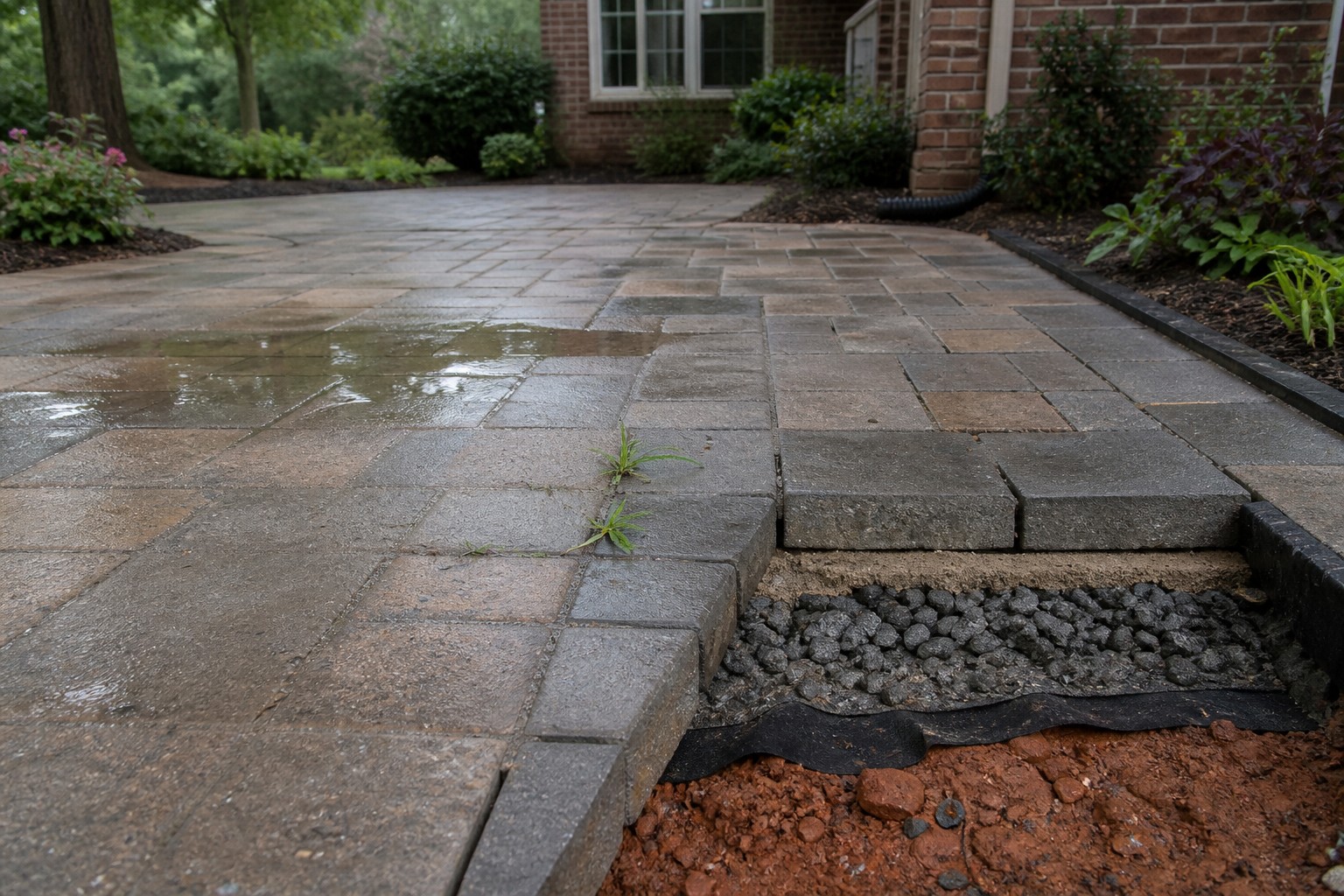
A Charlotte paver patio does not reach the end of its useful life on one birthday. Individual units may remain sound while a low spot, loose edge, or failed joint makes part of the patio unusable. The useful question is therefore not “How many years do pavers last?” It is “Which layer has changed, how much area is affected, and will resetting the surface correct the cause?”
On Piedmont lots, that diagnosis begins after rain. Water reveals the low points, soft edges, blocked outlets, and runoff arriving from the house or lawn. Mark the wet area before it dries. Then compare the pattern with the joint, edge, and base symptoms below. A small surface repair is reasonable only when the support and water path remain stable.
Read the failure pattern before lifting the first unit
| What you see | Layer to investigate | First field check | Repair direction |
|---|---|---|---|
| One chipped or cracked paver; surrounding surface stays flat | Surface unit | Confirm adjacent units do not rock and joints remain tight | Replace the unit with a matching spare; do not disturb a stable base unnecessarily |
| A shallow, contained depression that holds water | Bedding and aggregate base | Outline the wet area after rain and check whether a downspout or slope feeds it | Lift and reset the section only after the water source and base condition are understood |
| Outer rows spreading or rotating away from the field | Edge restraint and its anchors | Inspect the full affected edge, not only the most visible gap | Restore the restraint, rebuild support at the margin, then relay displaced units |
| Joint material repeatedly disappears from the same run | Joint, cleaning method, water path, or movement below | Watch where roof and surface water travel; check for rocking units | Correct movement or washout before refilling the joint |
| Several zones settle again after prior resets | Base, subgrade, drainage, or buried disturbance | Compare repair limits with the new settlement and look for utility or root corridors | Open a representative section and define a base-rebuild area rather than repeating cosmetic resets |
| Water flows from lawn or roof across the patio carrying silt | Site grading and drainage | Trace the source during a storm and record the discharge point | Reroute or manage inflow; cleaning joints alone will not stop recurrence |
No single symptom proves a hidden cause. A low spot may reflect thin base, poor compaction, water migration, a buried trench, or a disturbed edge. The table is a triage tool: it identifies what must be exposed or measured before a scope is written.
Why red Piedmont clay changes the diagnosis
NC State Extension describes much of Piedmont subsoil as high in clay and notes that compacted soil has less infiltration and greater runoff. Clay’s small pore spaces also make it difficult to wet and aerate evenly. That does not mean every red Charlotte soil is poorly drained—the Extension’s soil guide notes that red, brown, and yellow Piedmont subsoils can be well drained—but compaction, grading, fill, and the actual soil profile decide how water behaves on a lot.
That distinction matters beneath a patio. The native soil is not the finished bearing surface; the construction system must provide a stable, draining support layer above it. If the subgrade was disturbed unevenly or the base was not built consistently, water and load reveal the weak zones. Repeatedly adding bedding material under the same depression can raise the pavers for a season without correcting a moving or saturated layer below.
Use the site’s Charlotte soil guide to frame the clay and compaction questions, but treat the exposed section under the patio as the controlling evidence. Color alone is not a base specification.
The edge tells the story earlier than the middle
Interlocking units rely on confinement. When an edge restraint loosens, the outside row can migrate, joints widen, and the loss of confinement moves inward. Early repair is usually smaller because the field has not yet spread. Once several rows rotate or separate, restoring the original pattern requires more lifting and careful re-establishment of the margin.
Inspect where the patio meets beds, steps, walls, and driveways. Look for exposed anchors, missing support beneath the restraint, erosion at a downspout, and roots or excavation that changed the edge. Do not pack loose soil against a failed margin and call it complete. The written repair should name the restraint material, anchoring, base support, and the number of courses to be lifted.
Joint loss is evidence, not just a housekeeping problem
Weeds in paver joints are often treated as proof that plants are growing all the way up from the subgrade. In practice, windblown soil and organic material can accumulate near the surface and support germination. The useful observation is whether joints remain uniformly filled and whether any pavers rock or spread.
If joint material vanishes from the same line after every storm, trace the water. If it disappears after pressure washing, change the cleaning method. If the joint opens because the edge moves, repair confinement before adding material. Repeated top-offs without a cause check hide a progressing defect.
A puddle needs a boundary, depth, and duration
Photographing “standing water” is not enough. Mark the outline, measure the deepest point, and record how long it remains after rain ends. Check whether the water is confined to a few pavers or follows a broader grade toward the house. Observe downspouts, roof valleys, irrigation, and uphill lawn runoff at the same time.
Charlotte Storm Water Services explains that rain runs off hard surfaces rather than soaking into the ground and is conveyed toward local creeks and lakes. Its public One Water site uses a permeable-paver patio to show the alternative: water enters designed joints and filters through sand and stone layers before reaching soil or an underdrain. That is an engineered system, not a performance label that can be applied to an ordinary patio because its joints look wide.
A conventional patio should shed water along its intended grade without sending it toward the foundation or eroding a bed. A true permeable pavement must preserve its infiltration or detention pathway. Each calls for a different repair diagnosis.
Reset a section when the cause and boundary are both contained
A sectional reset is a defensible choice when the affected area has a clear limit, surrounding pavers remain level and confined, the base outside the defect is stable, and the source of settlement or water can be corrected within the opening. The work should extend beyond the visible low point far enough to create a smooth transition, not leave a sharp ridge around a patched rectangle.
Bank matching replacement units before work if the product is discontinued or weathered. Lift in an order that preserves undamaged pavers, separate reusable units from broken ones, and photograph the exposed layers. The preimage becomes evidence if the same area moves again.
Rebuild the base when the defect keeps escaping the patch
A broader base repair is more credible when settlement crosses several zones, edges and field move together, previous resets have failed, or opening the patio reveals inconsistent aggregate thickness, contamination, voids, or saturated material. The rebuild limit should follow observed defective support, not an arbitrary square.
This is where a complete proposal matters. The site’s Charlotte hardscaping page lists the components that belong in a patio scope. For a diagnostic rebuild, require measured removal area, disposal, subgrade correction, aggregate type and compacted depth, lift sequence, bedding, edge restraint, joint material, drainage changes, and final elevations. Price without those quantities is not comparable.
Permeable pavers have a separate maintenance contract
Charlotte-Mecklenburg’s current built-upon-area guidance says an approved permeable pavement system can partially reduce built-upon area when installed and maintained in accordance with the Stormwater Control Measure Design Manual. The same guidance says approval is required from the applicable Stormwater Review Engineer. It also distinguishes maintenance responsibility in the City from several surrounding municipalities and unincorporated Mecklenburg County.
That means a homeowner should not replace clogged permeable joints with conventional joint material or assume that surface appearance is the whole system. The aggregate reservoir, underdrain if present, inflow limits, adjacent grading, and maintenance method belong to the as-built design. If approval or stormwater credit depends on the system, retrieve those records before changing it.
A useful inspection calendar follows events, not marketing warranties
- After a heavy storm: photograph ponding, inflow, washout, and discharge while the evidence is visible.
- After freezing weather: walk the surface for rocking units, lifted edges, and new trip points.
- Before aggressive cleaning: identify the joint material and use a method that will not remove it.
- When a gap first opens: inspect the connected edge immediately rather than waiting for several courses to spread.
- Before adding a roof or downspout nearby: recalculate where the new runoff will land.
- Before requesting bids: mark repair limits and give every bidder the same observed conditions.
For budget context, keep this diagnostic scope separate from generic installed-square-foot pricing. The existing Charlotte landscaping cost guide covers planning ranges; a repair estimate must price the measured opening, salvage, base correction, drainage, and relaying work actually required.
Five questions that expose a cosmetic repair
- What observation identifies the failed layer?
- How far beyond the visible symptom will the patio be opened, and why?
- What happens to the water source before the pavers are relaid?
- Which units will be reused, which replacements are available, and how will color variation be handled?
- What readback—elevations, drainage test, edge alignment, or post-storm inspection—will show that the cause was corrected?
If a proposed patio change also affects lot drainage, built-upon area, or an approved stormwater system, confirm the review path before work. The site’s Charlotte permit overview is an orientation layer, while City and Mecklenburg reviewers remain the authority for the address.
Answers for a patio that has started to move
How long should a paver patio last in Charlotte?
There is no defensible single local lifespan. Sound units can be lifted and reused, while drainage, base, edge, and joint failures can make a younger patio need repair. Judge the system by measured movement and recurring water behavior, not age alone.
Can a sunken section simply be filled underneath?
Only after the cause is identified and the surrounding support proves stable. Filling a depression can correct elevation but will not cure ongoing saturation, erosion, a failed edge, or inconsistent base.
Do weeds mean the entire patio base failed?
No. Organic material can collect near the joint surface. Inspect joint loss, paver movement, edge restraint, and water flow before connecting weeds to a deeper structural defect.
Are all paver patios permeable?
No. A permeable pavement is an engineered system with designed joints and subsurface layers. Charlotte-Mecklenburg guidance ties built-upon-area treatment to approved installation and maintenance, not to the word “paver.”