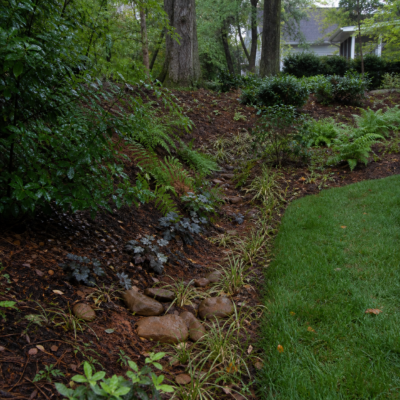
Adding or fixing a sprinkler system in Charlotte comes down to three things: knowing what Charlotte Water requires, hiring a contractor the state licenses, and designing for red clay and an uneven rainfall record. A licensed irrigation contractor installs the system, not us. This guide covers the planning side. Call (704) 318-2474 or request a free quote to talk it through before you collect bids.
Who is allowed to install irrigation in North Carolina?
State law, General Statutes Chapter 89G, requires an irrigation contractor’s license for anyone who constructs, installs, expands, services or repairs irrigation systems for pay. Exemptions include property owners working on their own property and projects under $2,500. You can look up a contractor’s license on the NC Irrigation Contractors’ Licensing Board website before hiring.
The same board publishes the minimum standards quoted on this page. A few are easy to check on any system, whoever installs it:
- Every new automatic system has to include a rain or moisture shut-off.
- Mainline and lateral pipe needs at least 12 inches of cover.
- Heads are spaced for head-to-head coverage: no more than 60 percent of the spray diameter apart for sprays and 50 percent for rotors.
- No spray onto streets, sidewalks, driveways, buildings or the neighbour’s lot.
- An isolation valve between the meter and the backflow assembly.
- At handover, the owner gets a zone-by-zone report, a seasonal watering schedule and winterization instructions.
The license lookup is at nciclb.org. Ask for the license number in the quote, then check it there.
What should I decide before I call irrigation contractors?
Decide what the system is for: turf, beds or both. Then list your zones in rough terms (sun, shade, slope, beds), whether you are on city water or a well, and whether you want a smart controller. Contractors can then price the same design, and the quotes compare line by line instead of by total.
Zone count is set by how much water your supply can deliver at once and by how many different areas need their own schedule. More sun and shade changes, more slopes and more beds mean more zones. Tying into the house line, adding a separate irrigation meter or running from a well are three different jobs, and the quote should say which one it prices. Our Charlotte landscaping cost guide gives the wider market picture. This page does not quote installation prices, because the number depends on the contractor and the site they see.
Do I need a backflow preventer on an irrigation system in Charlotte?
Yes. Charlotte Water requires a backflow prevention assembly on any home with an irrigation system, and since March 24, 2003 new systems have needed a reduced pressure principle assembly. It has to be tested by an approved tester, who sends the results to Charlotte Water. The utility asks for that test every year.
The assembly keeps lawn chemicals and soil bacteria from being drawn back into drinking water. A few practical points from Charlotte Water’s backflow page and its construction guidance:
- Older systems with an approved double check valve assembly are grandfathered until that assembly needs replacing.
- You can pick any tester on the approved list. All of them can test anywhere in Mecklenburg County.
- Knowing where the assembly is, and getting it tested, is the customer’s responsibility.
- Repairs to the assembly itself have to be done by a licensed plumber.
How do Charlotte’s clay soil and rainfall affect sprinkler design?
Clay takes water slowly, so a zone that runs too long sends water down the driveway. Rain here is also erratic: Charlotte’s normal is 3 to 4.2 inches a month, but September brought 0.19 inches in 2019 and 9.49 inches in 2024. A system has to soak in short cycles and shut itself off when it rains.
Soil
Piedmont red clay compacts easily and drains slowly, and around Charlotte it is acidic, often pH 5.0 to 6.0. For irrigation, the number that matters is how fast it accepts water. The state standards tell designers to keep a sprinkler’s output below the soil’s intake rate or to use repeat soak cycles. That is why slow rotary nozzles suit clay slopes better than fixed sprays. There is more on the ground itself in our Charlotte soil guide.
Slope
Charlotte lots roll. The standards say to put heads at the top and the toe of a slope on separate zones, and to use check valves where grades exceed 5 percent so the lowest head does not drain the line after every cycle. They also say no runoff should travel more than 15 feet across pavement or reach a storm inlet.
Rainfall
National Weather Service records show how uneven it is. The annual normal is 41.63 inches. The first four months of 2026 brought 6.17 inches against a normal of 13.78, which is how the area ended up in Stage 2. A fixed schedule is wrong in both directions here: too much in a wet September, not enough in a dry one.
Trees
Mature oaks change the design twice. Their shade means the lawn under them needs less water than the lawn in full sun, so the two should not share a zone. And their roots mean trenches are routed around the root zone or bored under it. Where a trench has to enter a root zone, the standards say to cross it at a right angle and cut damaged roots cleanly.
Can I run my sprinklers under Charlotte’s Stage 2 water restrictions?
Yes, on your assigned nights. Odd-numbered addresses can water from 6 p.m. Tuesday to 6 a.m. Wednesday and 6 p.m. Saturday to 6 a.m. Sunday. Even-numbered addresses get 6 p.m. Wednesday to 6 a.m. Thursday and 6 p.m. Sunday to 6 a.m. Monday. Fines start at $100. Drip, soaker hoses and hand watering are allowed.
Stage 2 took effect May 15, 2026, and it was still posted on Charlotte Water’s drought page when we read it on September 30, 2026. A few things worth knowing:
- Each window spans two calendar days. A controller set for Wednesday at 5 a.m. is legal for an odd address. Wednesday at 7 a.m. is not.
- For a standard residential meter, fines are $100 for a first violation, $200 for a second and $300 for a third. Violations are reported through 311.
- Routine lawn maintenance, including fall aerating, overseeding and reseeding, is not eligible for a variance.
- If the utility moves to Stage 3, existing variances expire and no new ones are approved.
- Well water is not restricted. The rules apply to municipal drinking water.
- The Stage 2 goal is a 5 to 10 percent cut in use. As of September 25, 2026, the utility reported 12.1 percent.
Our Charlotte watering restrictions page tracks the current stage.
Is drip irrigation worth it in Charlotte?
For beds, shrubs and trees, yes. Drip puts water at the roots, so less is lost to evaporation and runoff on clay. It is also allowed under Charlotte Water’s Stage 2 restrictions, which limit sprinklers to two overnight windows a week. Where drip does not belong is on lawn.
What a properly built drip zone includes
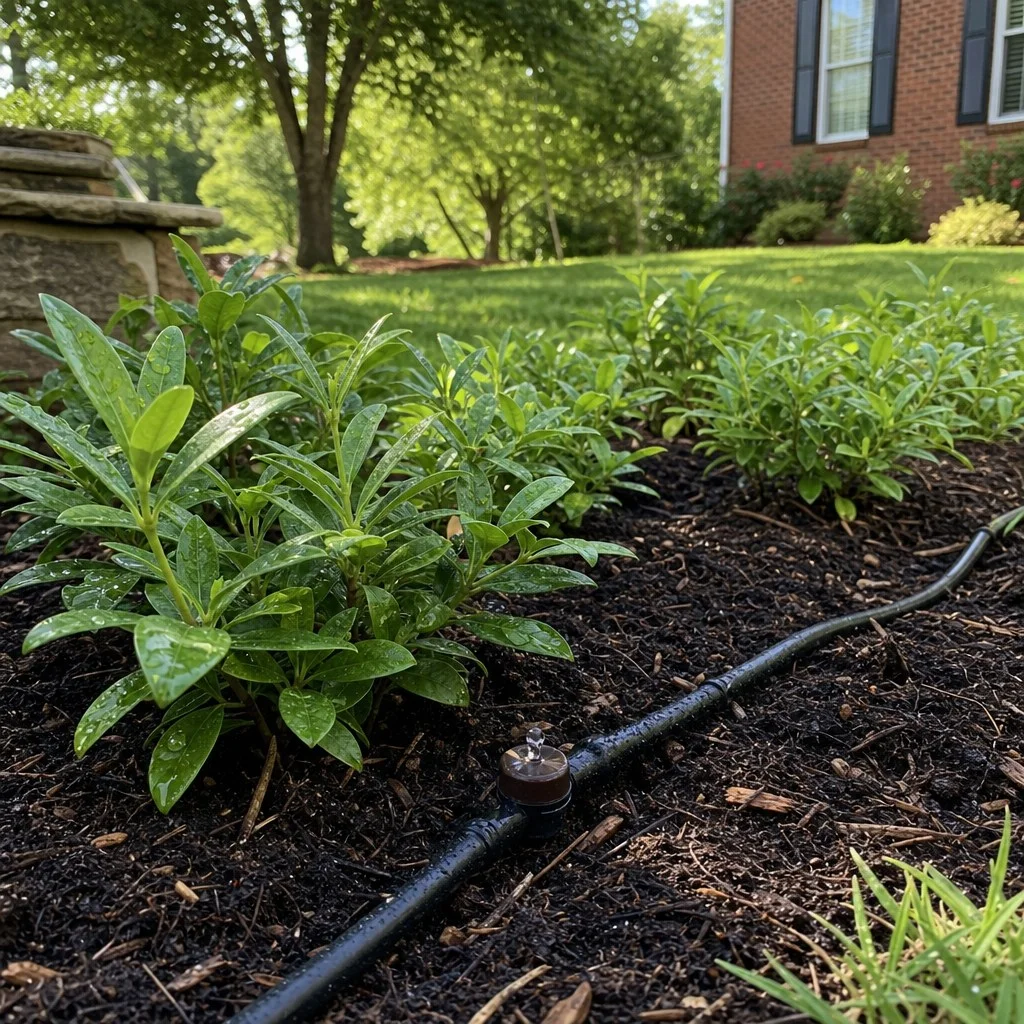
A drip zone is not a sprinkler zone with different ends on it. It runs at lower pressure and it clogs if it is built carelessly. The state irrigation board’s minimum standards list what a proper one includes, and it makes a good checklist for any quote:
- A filter at the valve to keep grit out of the emitters.
- A pressure regulator ahead of the tubing. City water pressure can rise without warning when mains are flushed, and unregulated drip tubing can be damaged by it.
- Pressure-compensating emitters so the first plant on the line and the last one get the same amount.
- Looped tubing. Connecting the ends of the lines evens out pressure, and if a line is cut, water still reaches both sides of the break.
- A flush point at the low end so the lines can be cleaned out.
- Its own zone. Shrubs, perennials and trees need different amounts than turf, and deep-rooted plants need different amounts than shallow ones.
Where drip works and where it does not
Drip is the right tool for foundation beds, shrub borders, hedges, vegetable gardens, containers and new trees. On Charlotte clay it has one more advantage: a slow drip gives the soil time to take the water in, where a spray head can put it down faster than clay absorbs it. The weak points are simple. Tubing under mulch gets cut by shovels and edgers, and nobody sees a leak until a plant wilts or a bed turns to mud.
Drip under current restrictions
Charlotte Water’s drought page says it plainly: hand watering, soaker hoses and drip irrigation are allowed. That makes drip the way to keep shrubs and trees alive between the two sprinkler windows.
Drip maintenance
Clean the filter and open the flush point at spring startup. Walk the beds with the zone running once or twice a season and look for wet spots and dry plants. After any planting or mulching, run the zone and check for cuts.
How much water does a Charlotte lawn need?
About 1 inch a week, counting rain. NC State Extension says to wet the soil 6 to 8 inches deep and not to apply the inch all at once; half an inch every three to four days suits most lawns. One inch over 1,000 square feet is 640 gallons, so measure what your system puts down.
Fescue and bermuda
NC State’s tall fescue calendar puts fescue at about 1 inch of water every week. If you let fescue go dormant in a dry summer, the guidance in Carolina Lawns is about a quarter inch every three weeks to keep the growing points alive. Bermudagrass also gets about 1 inch a week in the growing season. From September through November, NC State says bermuda usually does not need irrigation, as long as the soil does not get powder-dry.
Cycle and soak on clay
NC State’s instruction for clay is specific: water until runoff is about to start, stop, and wait 30 minutes for it to soak in. On a controller that means two or three short run times per zone, not one long one. The state’s irrigation standards call for a controller with at least four start times for exactly this reason.
Time of day
NC State says watering between 2 a.m. and 8 a.m. cuts down on certain lawn diseases. Stage 2 closes the window at 6 a.m., so the practical schedule right now is 2 a.m. to 6 a.m. on your assigned nights. Our Charlotte lawn watering guide covers schedules through the seasons.
What that water costs
Charlotte Water bills by the Ccf, which is 748 gallons. A 5,000-square-foot lawn needs 3,200 gallons for one inch, so four dry weeks at an inch a week is 12,800 gallons, or about 17.1 Ccf. On an irrigation meter at this year’s rates, the first 16 Ccf bill at $6.30 and the rest at $11.93, which comes to about $114. A 10,000-square-foot lawn uses about 34.2 Ccf over the same four weeks, about $318. Rain you do not have to replace is money you do not spend, which is the whole argument for a rain shut-off and a controller that reads the weather.
What is Charlotte Water’s Smart Irrigation Program?
It is a rate program for customers with efficient systems. If you have an EPA WaterSense approved smart controller and a working, annually tested backflow device, Charlotte Water caps your irrigation use at the Tier 3 rate, currently $6.30 per Ccf, so it never bills at the $11.93 Tier 4 rate. You reapply every year.
The utility estimates the program helps customers cut summer watering demand by more than 20 percent. On the 10,000-square-foot example above, the cap alone takes four dry weeks from about $318 to about $216. The program page has the application.
Irrigation meters
A separate irrigation meter measures outdoor water on its own. Charlotte Water offers two setups, a split from the existing service line or a dedicated line. It has eliminated capacity fees for residential split-service irrigation meters and lets customers spread the connection fees over 12 monthly bills. Irrigation meters bill at Tier 3 for the first 16 Ccf and Tier 4 after that. Whether one pays off depends on how much you water, and it is worth running the numbers before you commit.
What does the irrigation process look like, step by step?
There are seven steps: a site survey with a pressure and flow test, a zone design, utility marking and the backflow connection, trenching and pipe, heads and drip, controller setup, and a walkthrough. A typical residential system is two to four working days on site for the licensed contractor. Rock, roots and rain add time.
- Site survey and pressure test. The contractor measures static pressure and flow at the connection, maps sun, shade, slope, beds and trees, and finds the meter and any existing backflow assembly. Pressure and flow decide how many heads a zone can carry, so the test comes before the design. About an hour.
- Design and written quote. Zones are drawn so turf, beds, sun, shade and slopes each get their own schedule. You decide on drip areas, controller type and whether to add an irrigation meter. You should get a flat written quote for that design, with the license number on it.
- Utility marking and water connection. Underground utilities are marked through 811 before any trench is opened, which state law requires. Walk the yard with the contractor for private lines like lighting wire, drains and propane. The backflow assembly and isolation valve go in at this stage. Marking takes a few days to come back, and that sets the start date.
- Trenching and pipe. Mainline and laterals go in with at least 12 inches of cover, and trenches are backfilled and compacted in layers so they do not sink later. Sleeves go under walks and drives. This is the step where roots, rock and old buried debris slow things down. Usually one to two days.
- Heads, valves and drip. Valves are set in boxes, heads go on flexible swing joints so a mower wheel does not snap them, and drip zones get their filter, regulator and tubing. Each zone is flushed before the nozzles go on. About a day.
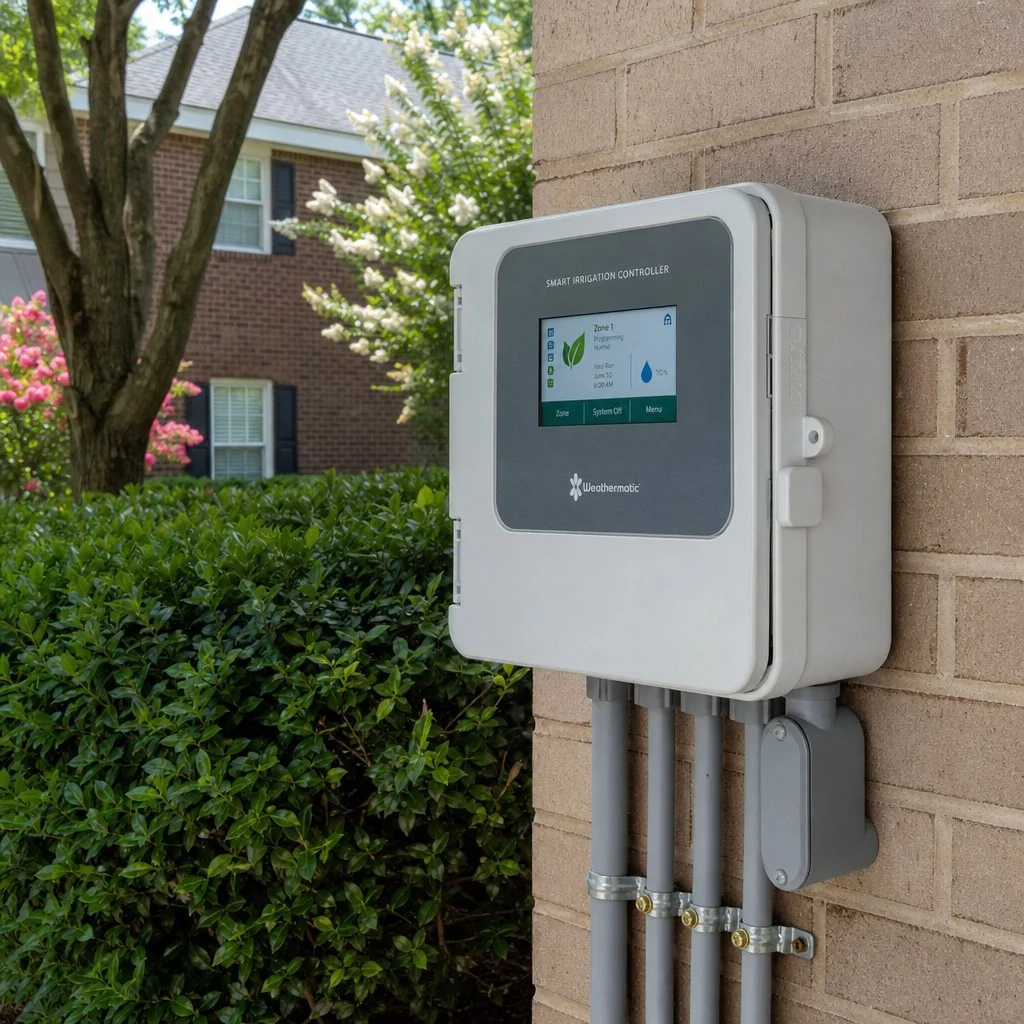
- Controller and sensor setup. The controller is mounted, the rain shut-off is wired in, and each zone is programmed with cycle-and-soak run times for clay and the current watering days for your address. A couple of hours.
- Walkthrough. Every zone is run with you, arcs and reach are adjusted, and you are shown the shut-off and the backflow assembly. You should leave with the zone map, the seasonal schedule and winterization notes.
What should I check when comparing irrigation quotes in Charlotte?
Ask for the zone count, the backflow assembly type, the controller model, the pipe cover depth and a rain shut-off. Charlotte Water requires a reduced pressure backflow assembly on new systems, and North Carolina standards call for a rain or moisture shut-off. A quote missing those items is not comparable to one that has them.
- License. The contractor’s irrigation license number, checked on the board’s lookup before you sign.
- Design. A zone map or at least a zone list, with drip and spray separated.
- Backflow. Assembly type, enclosure and who arranges the first test.
- Controller. Model, whether it is WaterSense approved, and how many start times it carries.
- Permits and utility. Who handles any meter work or utility paperwork.
- Handover. The zone report and seasonal schedule the state standards call for.
When should I winterize and start up a sprinkler system in Charlotte?
Winterize in November and start up in March or April. National Weather Service records for the last ten seasons put Charlotte’s first freeze between October 19 and November 29 and its last between March 7 and April 23. The above-ground backflow assembly is the most exposed part, so protect it before the first hard freeze.
Charlotte gets enough cold to do damage. Those same records count 40 to 59 freeze days in every one of the last ten winters. Water left in an above-ground assembly or a shallow line expands when it freezes, and the crack shows up in spring as a leak. The state standards describe winterization as shutting off the supply, opening the drains and using compressed air where needed. Spring startup is the reverse, done slowly, with every zone checked before the schedule goes back on. Our Charlotte landscaping calendar places both in the month-by-month order of seasonal tasks.
What are the most common sprinkler problems in Charlotte?
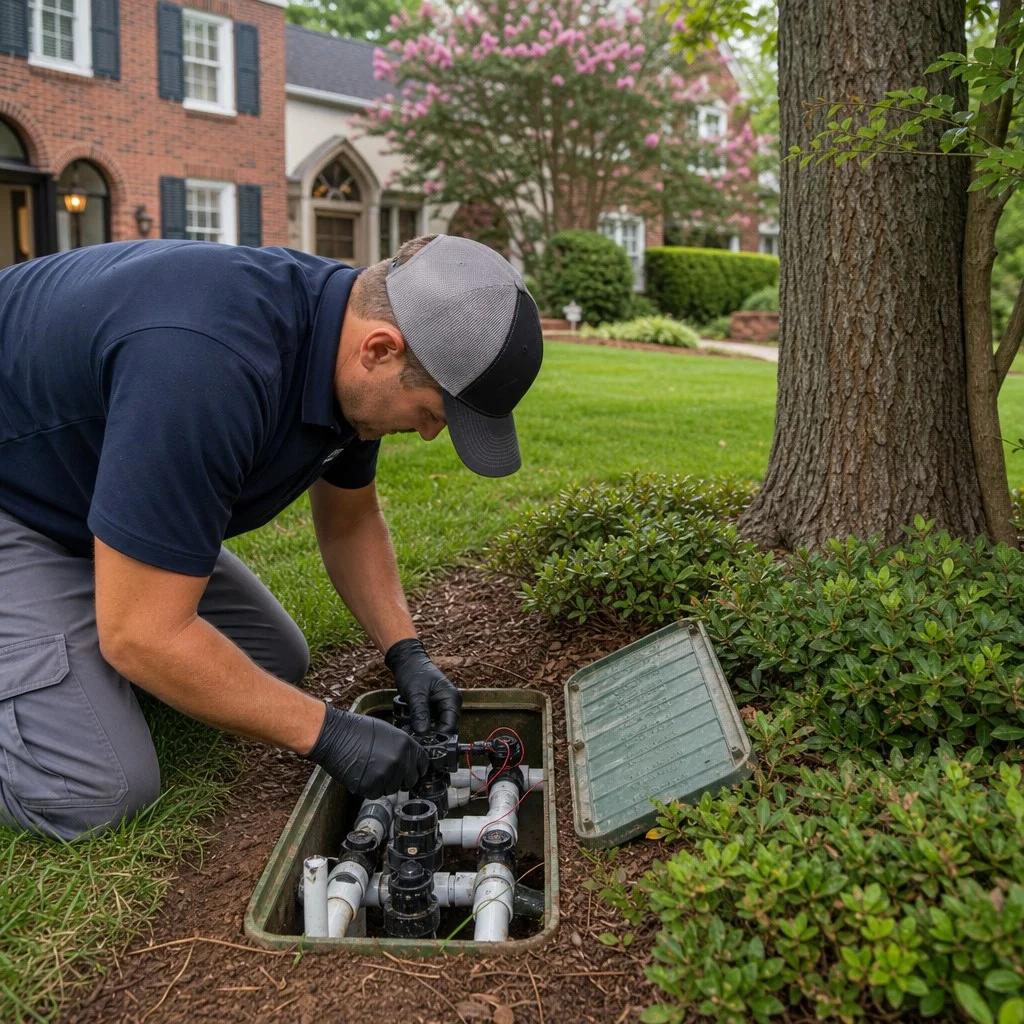
Broken heads from mowers and freezes, valves stuck open or shut by debris or bad wiring, a zone with low pressure from a line break or clogged filter, and controllers that have drifted off schedule. A licensed irrigation contractor diagnoses these, and you should get a price before work goes beyond basic diagnostics.
- A geyser or a dry circle: a broken or clogged head.
- A zone that will not shut off: debris in the valve or a failed diaphragm.
- A zone that will not come on: a bad solenoid or a cut wire.
- One weak zone: a cracked lateral, usually marked by a soggy strip of lawn.
- Water running down the curb: run times too long for clay, or heads aimed at pavement.
- Watering on the wrong night: a controller that was never updated for Stage 2.
What does a typical Charlotte irrigation scope look like?
Four scopes cover most homes: a new system on a quarter-acre fescue lot, a drip retrofit for beds, a controller tune-up to qualify for the utility program, and yearly seasonal service. Each is a typical scope, not a quote and not an account of a particular job, written to show what the quote should list.
A typical seven-zone system on a quarter-acre fescue lot
About 5,000 square feet of fescue in front and back, foundation beds, a sloped side yard and city water. The scope is a reduced pressure backflow assembly, five turf zones, two drip zones for beds, a smart controller and a rain shut-off. The side-yard slope is clay, so it should get rotary nozzles, check valves and short repeat cycles. Water math: at 1 inch a week with no rain, about 17.1 Ccf every four weeks, roughly $108 at the Tier 3 cap.
A typical drip retrofit for foundation and island beds
A house with an older spray system that waters shrubs and siding together. The scope is to cap the bed sprays, add a filter and pressure regulator at two valves, lay pressure-compensating tubing under the mulch, loop the ends and add flush points. Under Stage 2 the shrubs can now be watered on days the lawn cannot.
A typical tune-up to qualify for the Smart Irrigation Program
A ten-zone system with a basic timer and a few tired heads. The scope is to replace the timer with a WaterSense smart controller, adjust zones and get the backflow assembly tested. If the assembly is an older double check valve it is grandfathered, but the program still needs a passing annual test.
Typical yearly service on an existing system
Any system with an above-ground backflow assembly needs a fall blowout and the annual backflow test. The first freeze has come as early as October 19, so the blowout should not wait for December.
Which Charlotte neighbourhoods and nearby towns do these rules cover?
The watering schedule, backflow rules and rates on this page are Charlotte Water’s, so they apply across Charlotte neighbourhoods such as Ballantyne, Piper Glen, SouthPark, Myers Park and Steele Creek. Homes on another utility or on a well follow different rules, so confirm which applies before you set a controller.
Nearby towns include Gastonia, Indian Trail, Waxhaw, Mooresville, Matthews, Concord, Mint Hill and Davidson. Every town we cover is listed on the areas we serve page.
Irrigation also touches the rest of the yard. New landscape designs usually mean drip changes, hardscape needs lines moved before the stone goes down, and lawn mowing is where broken heads get spotted. Leaf removal is when heads hidden under debris get found.
Want to plan a system that waters the right amount on the right nights? Call (704) 318-2474 or request a free quote and we will help you scope it before you collect bids.