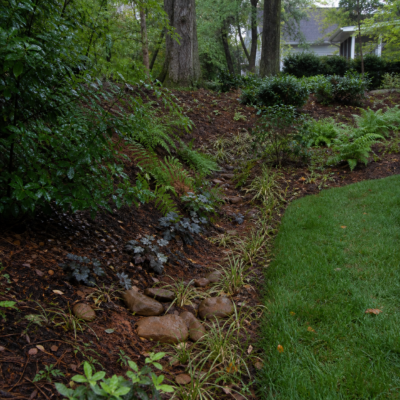
Property overview: How does Commercial Landscaping work for Charlotte properties?
Commercial programs in Charlotte account for Piedmont clay, fescue and warm-season turf, leaf load, drainage, and the access needs of each Mecklenburg site. Typical pricing: Custom monthly contracts. Free written estimates. Call (704) 318-2474 for quotes throughout Mecklenburg County.
Charlotte Pro Landscape provides commercial landscaping in Charlotte, NC for HOAs, office parks, retail centers, apartment communities, churches and schools. Most small to mid-size commercial sites run on an annual contract billed at a flat monthly rate, roughly $800 to $4,500 depending on scope. Call or request a free quote to set up a site walk.
Call (704) 318-2474 or get a free quote.
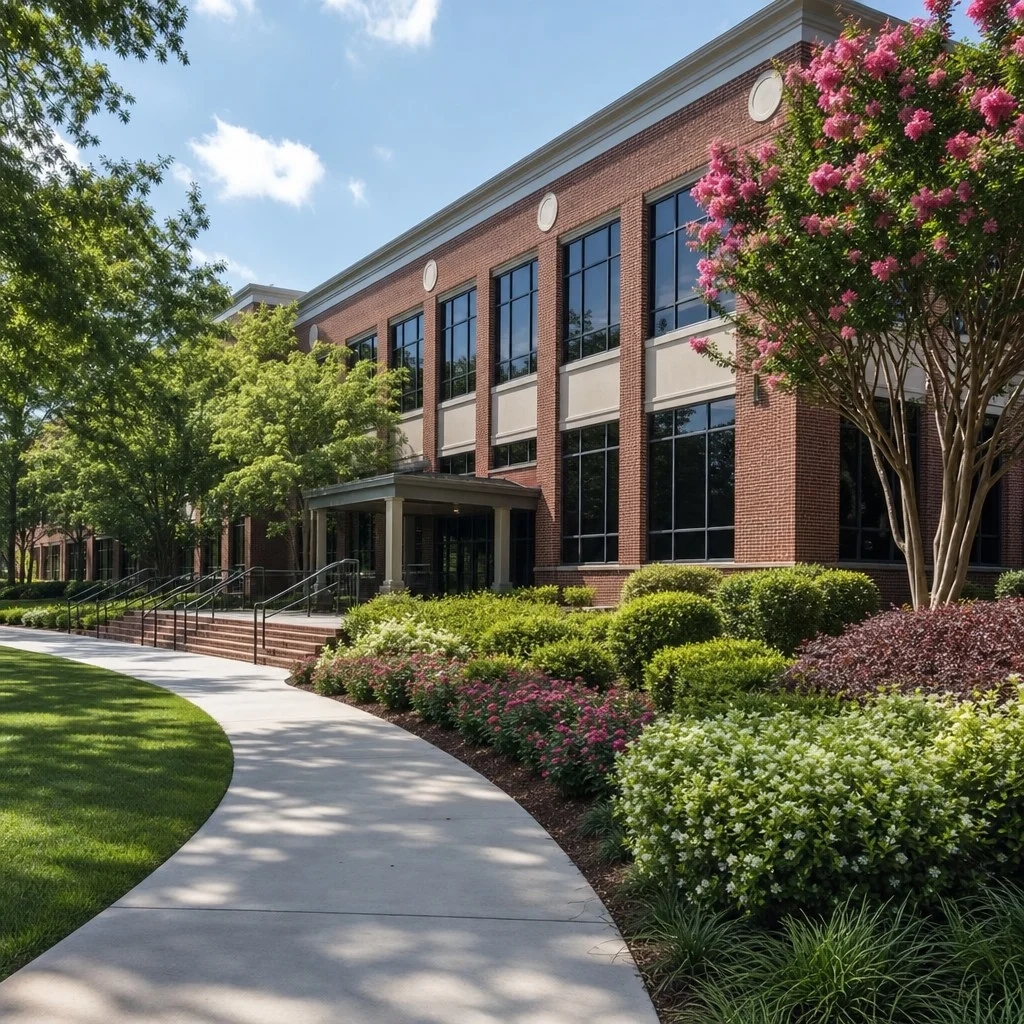
What does commercial landscaping in Charlotte include?
A commercial landscaping contract in Charlotte usually covers weekly mowing in the growing season, string trimming, edging, blowing off walks and lots, bed care, pruning, mulch twice a year, turf fertilization, seasonal color, irrigation checks, fall leaf removal and winter storm cleanup. Everything is written into one scope with one monthly bill.
You can also carve pieces out. Some sites keep an existing irrigation or tree vendor and only want us on grounds care. That works, and we note the other vendor’s lines in our scope so a broken head doesn’t sit for weeks with each side assuming it’s the other’s job.
A mowing visit has a set routine: cut at the right height for the grass on that part of the property, trim around every sign post, light pole and curb stop, edge beds and concrete, pick trash out of the turf first, and blow clippings off walks and parking stalls. The property contact then gets a short report with photos of anything that needs a decision, like a sprinkler head cracked by a delivery truck or turf thinning in a hot corner. Bed work, pruning and mulch run on their own schedule.
Office parks and corporate campuses
Large turf panels, long bed runs along building faces, parking lot islands with code-required trees, and often a stormwater pond or bioretention area out back. Sites run from about 5,000 square feet of landscaped area up to multi-acre campuses. Campuses with mature canopy carry more leaf and pruning work. Most office sites get weekly visits from spring green-up through fall, with a monthly walk of the whole property.
Retail centers and shopping plazas
Retail is about the parking lot and the storefront. Islands, entry beds and the road frontage are what shoppers see. Mowing and blowing happen outside peak hours so stalls stay open, litter pickup in the beds matters more here than almost anywhere, and seasonal color at the entries does a lot of work for a small cost.
HOA common areas and entrances
Monument entrances, clubhouse and pool beds, walking trails, common turf, and usually a pond. Boards want the entrance right every week and no surprise invoices, which shapes how we report and bill.
Apartment and townhome communities
Multi-family sites mix high-visibility areas, like the leasing office and amenity center, with a lot of plain turf between buildings. Residents are home during the day, so we give notice before loud work and plan around move-in days and community events.
Churches, schools and medical offices
Smaller sites with tight schedules. Churches want the grounds sharp before the weekend. Schools need work done outside drop-off and pickup. Medical and professional offices need clear, safe walkways for patients. Many of these run on weekly or every-other-week visits with a seasonal cleanup in spring and fall.
Other services on the same contract
A commercial contract can pull in any of our other work, so you deal with one vendor and one invoice instead of four. That includes routine mowing as the base, landscape design for entrance and bed renovations, hardscape work like retaining wall and paver repairs, irrigation service and controller programming, and seasonal leaf removal through the fall. Large industrial sites and distribution centers fall outside our focus.
How much does commercial landscaping cost in Charlotte, NC?
Most small to mid-size commercial properties in Charlotte fall between $800 and $4,500 a month on an annual maintenance contract. Where a property lands depends on acres of turf, linear feet of beds, how many trees and islands there are, visit frequency, and what’s bundled in, like mulch, color, irrigation and leaf season.
| Line item | Typical Charlotte range | How it’s billed |
|---|---|---|
| Commercial maintenance contract, small to mid-size site | $800 to $4,500 per month | Flat monthly, annual term |
| Mulch, installed | $60 to $120 per cubic yard | Per application, usually in the contract |
| Fescue sod, installed | $1.50 to $3.00 per sq ft | Line item, quoted per area |
| Bermuda or zoysia sod, installed | $1.75 to $3.50 per sq ft | Line item, quoted per area |
| Soil grading and amendment | $0.50 to $1.50 per sq ft | Line item, quoted per area |
| Irrigation repairs and zone adjustments | $100 to $400 | Per repair, approved before work |
| Annual backflow test | $75 to $150 | Per assembly, once a year |
| Storm cleanup, tree removal, hardscape repair | Quoted after assessment | Separate line item |
The monthly range is the one we publish for commercial work. The unit prices are the same ones in our Charlotte landscaping cost guide, so a mulch yard or a square foot of sod costs the same on a commercial site as it does anywhere else we work. Seasonal color is quoted per rotation, since the plant count and bed size change from one property to the next.
Per visit, monthly contract or per acre?
You’ll see all three in Charlotte bids. Per-visit pricing makes the bill swing, heavy in May and June and nearly nothing in January. Per-acre pricing compares open turf quickly but ignores beds, islands, slopes and trees, which is where the labor goes on most commercial sites. We price the year’s visits and tasks, then split the total into twelve equal payments.
What pushes a commercial quote up or down
- Beds versus turf. Open turf mows fast. Beds need weeding, pruning, edging and mulch, so a bed-heavy site costs more per acre.
- Parking lot islands. Every island is its own trim, edge and blow stop. Twenty small islands can take longer than an acre of lawn.
- Slopes and pond banks. Steep red clay banks often need trimmers or a slope mower instead of a standard deck.
- Frequency and hours. Weekly visits on frontage, every other week out back, and before-opening or quiet-hour windows all change crew time.
- Canopy. Mature oaks and maples turn fall into a multi-week leaf job.
How are commercial landscaping contracts structured?
Our commercial contracts run on an annual term with a written scope and a flat monthly bill. Contract work isn’t billed per visit or by time and materials. Anything outside the scope, like added beds, storm cleanup or an extra color rotation, is priced as a separate line item and approved before it’s done.
The scope spells out, area by area, what gets done and how often: mowing by season, bed visits, mulch rounds and depth, fertilization, color rotations, irrigation checks and leaf season. If a task isn’t written down, it isn’t included. A board can hold us to the list, and nobody argues later about the back fence hedge.
Renewal and changes
Contracts renew annually, and any change in price or scope is given in writing at least 30 days before the renewal date. That gives a board time to review it at a meeting.
Invoicing
Billing is set up to match how your office pays: PDF invoices by email, upload to a management portal, ACH, or a card on file. Multi-site owners can get one invoice per property or one combined.
How does a commercial landscaping contract start, from first call to the first service week?
It starts with a site walk with your manager or board, then a written scope and price, a contract, and a setup period where we map the property and learn its irrigation, trees and stormwater areas. The first service week follows. Expect two to four weeks from first call to first visit on most sites.
- First call or quote request. We ask for the address, the type of site, its rough size, who decides (manager, owner or board), and whether there’s a current scope to match. A copy of your existing scope speeds things up.
- Site walk. We walk the property with your manager or a board member, usually 30 to 60 minutes. We note turf types, bed runs, islands, slopes, ponds or rain gardens, controllers and backflow assemblies, and trees that look code-required or sit in a tree save area.
- Measurement and scope draft. We measure turf and beds from the walk and aerial imagery and write the scope area by area, with frequencies by season. The usual mistake here is an omission, like a back pond nobody mentioned, so questions come before the price. Allow about a week.
- Proposal and contract. You get the full scope, the monthly price, the items priced separately, and the renewal terms. Boards often need a meeting to approve. Nothing starts until it’s signed.
- Setup. We check each controller against Charlotte Water’s current rules and note backflow test dates, SCM and tree save locations, gate codes, quiet hours and staging spots. Problems found here, like a controller set for the wrong nights, go to you in writing with a price before any repair.
- First service weeks. Early visits run longer while crews learn the site. Expect an extra cleanup pass on beds and edges in the first month.
- Monthly walk and report. Once the routine is set, you get visit reports with photos plus a monthly walk of the whole site. Scope changes get written up and priced as they come up, not saved for renewal.
What does the year look like on a Charlotte commercial maintenance calendar?
Spring is preemergence, green-up and the first mulch. Summer is weekly mowing, irrigation checks and heat stress. Fall is the big turf month for fescue: aeration, overseeding and fertilizer, followed by leaf season. Winter is pruning, debris, the second mulch round if it’s scheduled then, and storm cleanup when ice comes through.
| Season | Typical commercial work in Charlotte |
|---|---|
| Mid-February to early March | Preemergence on bermuda turf; preemergence on fescue in early March; dormant pruning of summer-flowering shrubs; first fescue feeding in February |
| March to May | Weekly mowing begins as fescue grows; spring mulch; spring color install; irrigation start-up and backflow test; bermuda fed several weeks after full green-up |
| June to August | Weekly mowing; fescue mowed higher; bermuda fed every four to six weeks; irrigation audits; watch for heat and drought stress; no herbicides on fescue |
| September to November | Core aeration and overseeding on fescue (September 1 to October 1); fescue fed mid-September and again in November; fall color rotation; leaf season starts |
| December to January | Leaf removal finishes; debris and storm cleanup; winter pruning; bermuda left unfed while dormant |
Fescue and bermuda on the same property
Charlotte sits in the transition zone, so most commercial properties grow two grasses and they want opposite things. Tall fescue does best in the shade under mature trees and around buildings. NC State Extension’s calendar calls for mowing it at 2½ to 3½ inches in spring and 3½ inches in summer, feeding it heavily in fall, and overseeding it between September 1 and October 1 at 6 pounds of seed per 1,000 square feet. Bermuda takes the full-sun areas, like road frontage and the hot islands, and it’s cut much lower, usually between 1 and 2½ inches. It gets fed in summer and not at all in winter. So our scope lists mowing heights and feeding by turf area, not by property.
Why is commercial turf in Charlotte so hard to keep green?
Charlotte’s Piedmont red clay is acidic, compacts under foot traffic and drains slowly, so roots stay shallow. Then summer heat and dry spells hit those shallow roots hard. Add parking lot heat, construction-fill soils around new buildings and two turf types on one site, and green commercial turf takes a planned program, not just mowing.
Most of Mecklenburg County sits on deep red clays of the Cecil type, weathered from Piedmont granite and metamorphic rock, often between pH 5.0 and 6.0. Lime goes into the program after a soil test, not on a guess. Around newer buildings the topsoil was often scraped off during grading, leaving compacted subsoil and fill, which is why islands at a ten-year-old shopping center can look worse than the lawn at an old church.
Rainfall averages about 41.6 inches a year at Charlotte’s airport weather station, but the averages hide wide swings: some months bring almost nothing, others several months’ worth in one storm, and clay sheds most of it. Fall core aeration on fescue opens the soil, and NC State recommends it for turf on clay or under heavy traffic. First freeze typically lands between mid-October and late November, last freeze between early March and late April.
How do Charlotte Water’s drought rules affect commercial irrigation?
Charlotte Water has had Stage 2 mandatory restrictions in effect since May 15, 2026. The utility says large HOAs, apartment communities and multi-family properties must follow the odd or even watering schedule based on the service address on the water account. Office and retail sites should confirm with Charlotte Water how their irrigation use is classified.
Odd addresses can run sprinklers from 6 p.m. to 6 a.m. on the Tuesday into Wednesday and Saturday into Sunday windows; even addresses get Wednesday into Thursday and Sunday into Monday. Drip and hand watering for plants are allowed. The utility says Stage 2 doesn’t apply to essential, community and business uses, but it names HOAs and multi-family outright, so we don’t assume any commercial account is exempt.
- Fines scale with meter size. A first violation is $100 on a 5/8 to 1 inch meter and $200 on a 2 inch or larger meter, climbing for repeats.
- Fall overseeding gets no variance. Charlotte Water lists routine lawn work, including fall aerating and overseeding, as not eligible, so seeding has to be watered inside the assigned windows.
- Wells are unrestricted. Zones on a well can run outside the schedule.
Our page on Charlotte watering restrictions tracks the current stage.
Backflow testing on commercial irrigation
Charlotte Water requires a backflow prevention assembly on irrigation systems, and since March 24, 2003 new irrigation systems have needed a reduced pressure principle assembly. Every assembly has to be tested by a tester on the utility’s approved list, who sends the results to Charlotte Water, and the utility asks for that test once a year. Repairs to the assembly itself are done by a licensed plumber. On a commercial site with several irrigation meters, that’s several tests, so we put each test date on the property’s calendar.
What do Charlotte’s tree rules mean for commercial grounds crews?
Under the Charlotte Tree Manual, trees planted to meet code are protected. Topping is prohibited, pruning them needs a tree work permit from the City, and a dead or missing code-required tree has to be replaced by the property owner in the next planting season. Tree save areas have their own limits on equipment and work.
Most commercial properties built under the City’s rules carry code-required trees along streets and property lines, in parking lot islands and in tree save areas. The manual treats compliance as permanent, and required trees are meant to grow to their natural height and form. Planted frontage trees that die or go missing are replaced during the next planting season, which the manual defines as November through March.
Tree save areas
Many commercial sites developed under the current rules carry tree save, and the Tree Manual’s green-area guidance works from a 15 percent requirement. Any change to a tree save area needs a tree work permit from Urban Forestry. On sites in the City’s Tier 3 and 4 place types, no mechanized equipment can work inside a tree save area, and the manual names chainsaws, pole saws and skid steers among the banned tools. Ground cover there has to be natural, non-dyed wood mulch or native vegetation, and invasive plants are expected to be removed, with vines cut at the base of the trunk at minimum.
Parking lot islands
Islands used for code-required trees can’t hold light poles, utilities or transformers unless the UDO or the Chief Urban Forester allows it. For a grounds crew, island trees are protected trees: deck scrapes, trimmer damage and mulch piled on the bark all shorten their life, and the owner pays to replace them.
Heritage tree canopy work
For heritage trees, the city’s manual sets out who may supervise canopy work like crown cleaning, limb reduction, cabling and dead-limb removal. We keep that work out of the maintenance contract and refer it to a qualified arborist, so it’s handled and documented under the city’s rules.
Who maintains the stormwater pond or rain garden on a commercial property?
The property owner does. The City of Charlotte requires long-term maintenance of stormwater control measures like wet ponds, rain gardens and wetlands, and those built after 2007 under the post-construction rules generally need a yearly inspection report from a licensed engineer, landscape architect or other qualified professional. Grounds crews handle the routine vegetation work in between.
These areas fall between vendors easily. The mowing crew avoids them, the inspector sees them once a year, and in between they grow over. The City suggests folding SCM checks into the landscaper’s routine, and that’s how we scope it: the pond bank or rain garden gets its own line, vegetation work follows the City’s maintenance guide for that SCM type, inlets and outlets get cleared of trash, and erosion or sediment buildup gets photographed and reported. Missed reports can bring notices or fines, so the inspection date goes on the property calendar.
How do you work with HOA boards and property managers?
HOA boards and property management companies are our main commercial clients. You get visit reports with photos of significant items, a monthly summary, written notice of any change, and invoicing that fits your accounting. We’ll attend a board meeting or a manager check-in when asked. The board reviews results instead of managing crews.
Boards turn over and managers juggle a dozen properties, so the record matters. Every scope change goes in writing with a price, and every issue goes in the visit report with a photo, whether it’s ours to fix or not. When a new board member asks why the entrance beds were redone, the answer is in the file. We also keep crews off the pool deck during open hours and work inside any architectural rules on plant choices.
What happens on a commercial property after an ice storm or a big wind event?
Contract properties go on the storm list. Crews clear debris from drives, walks and entrances first so people can get in safely, then do a damage walk and report what they found with photos. Major tree removal and hardscape repair are quoted separately once the damage is assessed, and nothing beyond cleanup starts without approval.
Order matters. Fire lanes, main drives, entries and accessible routes come first, then walks and parking, then turf and beds. Limbs hanging over walks and stalls get flagged right away. Code-required and heritage trees may need a permit before real cutting, so we document and price that work rather than start sawing.
What should you ask a commercial landscaping company before signing?
Ask for the full scope in writing, area by area, with frequencies by season. Ask what’s excluded, how extra work gets priced, and who your single contact is between visits. Ask how issues get reported and how fast they’re answered, and get the renewal and exit terms on paper before you sign.
- Mowing heights by turf type. One height for the whole property is a red flag on a fescue and bermuda site.
- Exit terms. Know the renewal date, the notice period and the early-termination terms.
Example commercial scopes in Charlotte
These are typical scopes, not jobs we’ve completed, written to show how a commercial price gets built. The math uses our published ranges. Your site walk sets the real numbers.
Example scope: HOA common areas with an entrance, clubhouse and pond
Site condition: a monument entrance off a busy road, clubhouse and pool beds, about two and a half acres of common turf split between fescue under the trees and bermuda in the open, a walking trail, and a wet pond with mowed banks. Red clay throughout, with thin turf where the builder graded.
- Weekly mowing, trimming, edging and blowing from spring green-up through fall, every other week in the slow months.
- Two mulch applications a year on about 6,000 square feet of beds at 2 inches.
- Fescue aerated and overseeded each fall; bermuda fed in summer.
- Pond bank mowing and inlet and outlet debris checks on the SCM line, with the annual inspection date on the calendar.
Local complication: overseeding falls in September, and under Stage 2 the common turf can only be watered on the community’s assigned nights, with no variance for overseeding. Seed rates and timing get planned around that.
Price math: 6,000 square feet at 2 inches is 1,000 cubic feet, or about 37 cubic yards per application. At $60 to $120 a yard installed, that’s $2,220 to $4,440 per round, or $4,440 to $8,880 a year for two rounds, which works out to roughly $370 to $740 a month of the contract. The mowing, bed and pond work sit on top of that, and the full contract lands inside our $800 to $4,500 monthly range, with the site walk setting where.
Example scope: strip retail center with parking lot islands
Site condition: a single-story strip center with front entry beds of about 1,500 square feet, fourteen parking lot islands averaging about 200 square feet each, narrow bermuda strips along the road, and code-required trees in most islands. Reflected heat off the asphalt bakes the islands every summer.
- Weekly visits from spring through fall, scheduled before stores open.
- Mulch twice a year on 4,300 square feet of beds and islands at 2 inches.
- Island trees checked for trunk damage; mulch kept off the bark; no topping.
Local complication: any island tree that dies is a code-required tree, and the owner has to replace it in the next November to March planting season. Catching stress early is cheaper than a replacement.
Price math: 4,300 square feet at 2 inches is about 717 cubic feet, or about 27 cubic yards. At $60 to $120 a yard, each mulch round runs $1,620 to $3,240. With little turf and a lot of hand work around islands, a center like this often sits toward the lower half of our monthly range.
Example scope: office building with a rain garden and a tree save area
Site condition: a three-story office building with about 20,000 square feet of fescue lawn, long beds along the building face, a bioretention area at the low corner of the lot, and a wooded tree save strip along the back property line. A thousand square feet of lawn by the side entrance is bare from foot traffic and a buried irrigation leak.
- Weekly mowing at 3½ inches in summer, with fall aeration and overseeding.
- Rain garden vegetation work on its own line, matched to the City’s maintenance guide.
- Tree save strip: invasive vine cutting at the trunk base, hand work only if the site is in a Tier 3 or 4 place type, non-dyed mulch only.
- Fescue sod on the bare patch after the leak is fixed.
Local complication: the bare patch traces back to the leak, so sodding first would waste the sod. The repair goes first, then the soil is loosened, then the sod.
Price math: overseeding 20,000 square feet at NC State’s 6 pounds per 1,000 square feet takes about 120 pounds of seed. The irrigation repair falls in the $100 to $400 range. Sodding 1,000 square feet of fescue at $1.50 to $3.00 a square foot is $1,500 to $3,000. The repair and sod are one-time line items. The mowing, beds and rain garden go into the monthly contract.
Where we provide commercial landscaping around Charlotte
We work on commercial properties across Charlotte, from Uptown and South End to SouthPark, Ballantyne and University City, and across Mecklenburg County. Outside the city we cover Matthews, Mint Hill, Huntersville, Cornelius, Mooresville, Concord, Belmont and Waxhaw. Multi-site owners can put several properties on one contract with one contact.
Town pages with local detail: commercial landscaping in Huntersville, commercial landscaping in Concord, commercial landscaping in Belmont, commercial landscaping in Waxhaw, and commercial landscaping in Matthews. For the full list, see all the areas we serve.
Ready to get a commercial landscaping price for your Charlotte property? Call (704) 318-2474 or use our free quote page, and we’ll set up a walk-through with your manager or board.
What does commercial landscaping in Charlotte cost per month?
Most small to mid-size commercial properties in Charlotte pay between $800 and $4,500 a month on an annual maintenance contract. The figure moves with turf acreage, linear feet of beds, parking lot islands, visit frequency and what is bundled in, such as mulch, seasonal color and leaf season.
Unit prices for mulch, sod and grading match the Charlotte landscaping cost guide, so line items can be checked against it.
Who offers commercial landscaping for HOAs and retail centers in Charlotte?
Charlotte Pro Landscape quotes commercial grounds care for HOA common areas, retail centers, office parks, apartment communities, churches and schools. Each site gets a walk, a written scope and one monthly bill, with the work split into mowing, beds, trees, irrigation checks and seasonal cleanup so every line is visible.
Start with a site walk by calling the quote page or (704) 318-2474, and see our areas we serve for coverage.
How do Charlotte commercial landscaping contracts work?
A commercial contract in Charlotte is usually a one-year term with a flat monthly payment. The scope lists every task and its frequency, so mowing, bed care, pruning, mulch twice a year, irrigation checks and storm cleanup are spelled out. Extras outside the scope are quoted before work begins.
Is commercial landscaping in Charlotte different from residential work?
Yes, in scale and in rules. Commercial sites run on larger equipment, set schedules and property manager reporting, and they carry stormwater, tree save area and irrigation backflow obligations that a single home rarely does. Residential work is quoted by the visit, commercial work by the year.
The Charlotte landscaping permits guide covers the tree and grading rules that apply on commercial grounds.
What should a Charlotte property manager ask before signing a landscaping contract?
Ask what is in scope and what is not, how often each task happens, who owns irrigation repairs, how storm cleanup is priced and how the contract renews or ends. A quote that cannot answer those five in writing is incomplete and tends to produce disputes by the second season.
Residential owners with a large lot can compare against lawn mowing in Charlotte pricing.
Which brief details matter to a property considering Commercial Landscaping?
Charlotte crews document each route visit against the approved scope, with Piedmont clay, fescue, drainage, and leaf-load issues recorded for the property manager.
“Our Charlotte crew runs Commercial Landscaping across Mecklenburg County every week. Same teams, same schedule, same standard.”— Charlotte Pro Landscape Operations Team
- Professionally managed local crews on dedicated weekly routes
- Serving multiple Mecklenburg County suburbs on fixed route schedules
- Operator-grade scheduling and reporting
- Free written estimates on every job