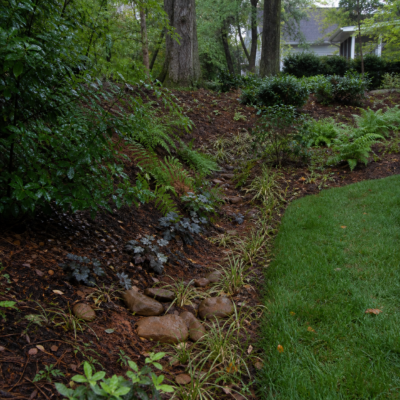
Property overview: How does the Landscape Design process work in Charlotte?
Charlotte landscape design weighs Piedmont clay, mature-tree shade, fescue or warm-season turf, native Carolina plants, drainage, and irrigation zoning. Typical pricing: $1,500-$15,000 per design. Free written estimates. Call (704) 318-2474 for quotes throughout Mecklenburg County.
A good landscape design in Charlotte starts with one question: where does the water go on red clay? This page covers what a residential design plan should contain, how the process runs, which city rules touch a planting project, and what to ask the contractor who builds it. The planting, grading and drainage work is done by a licensed contractor you hire, not by us. Call (704) 318-2474 or request a free quote to talk through a plan.
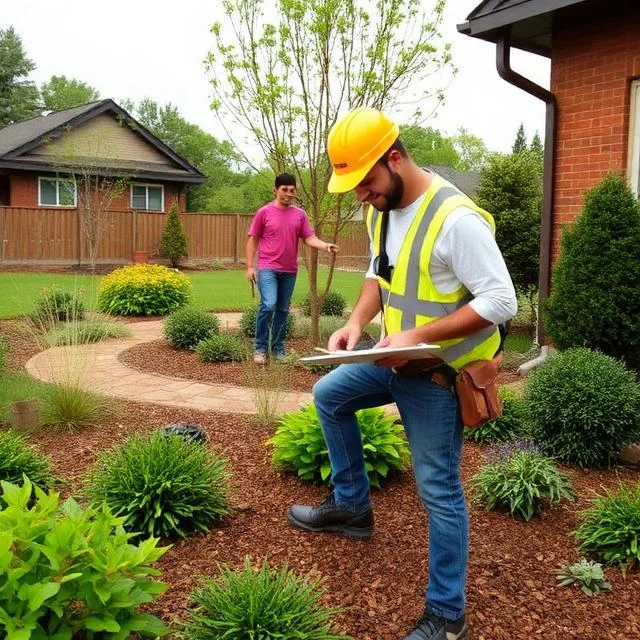
What does residential landscape design in Charlotte, NC include?
A scaled plan for your yard that names every plant, how many, how far apart and how big each gets. It also sets bed lines, grading and drainage moves, drip or sprinkler coverage, and any patio or wall. Around Charlotte, the plan has to answer one more question first: where does the water go on clay?
Landscape design here is part horticulture and part earthwork. The plant side means choosing species that handle humid summers, hard winter freezes and acidic clay. The earthwork side means shaping the ground so beds drain, roots get air, and a summer thunderstorm does not sit against your foundation for three days. A plan that skips the second half usually looks great for one season.
What you should get on paper
- A scaled site plan with the house, driveway, walks, existing trees worth keeping, and the sun pattern across the day.
- Bed layout with edges drawn to mowing widths, so the lawn crew is not fighting tight curves every week.
- A plant schedule listing each species, container size, count, spacing and mature height and spread.
- Grade and drainage notes showing where soil gets raised, where swales or drains go, and where downspouts discharge.
- Water coverage for new beds, either drip zones or changes to an existing sprinkler system.
- Hardscape footprint if a patio, walkway, step or low wall is part of the plan, with the materials named.
- A phase line if you would rather do the front this season and the back next season.
Is a design plan the same thing as landscape architecture?
No, and the difference is legal, not cosmetic. North Carolina’s landscape architecture statute, G.S. Chapter 89A, says nobody may call themselves a landscape architect or practice landscape architecture without being registered. The same law exempts drafting plans for where plants go on a site, and it exempts work on a single-family residential site.
Residential planting and layout plans sit in that exempt lane. A large commercial site or a subdivision is a job for a registered landscape architect, and if you already have their drawings, a contractor can build from them. Ask anyone offering a design to be clear about which of the two they are providing.
Who builds the landscape once the plan is drawn?
A licensed landscape or grading contractor does, and you hire and contract with them directly. The plan is what makes their bids comparable: it names plants and quantities, shows grade changes and marks where hardscape goes. With a plan in hand, three contractors price the same job instead of three different ideas of it.
Where the plan includes irrigation, North Carolina requires a licensed irrigation contractor for paid work, and that is covered on our Charlotte irrigation page. Where it includes patios or walls, the permit rules are on our hardscaping page. For budgeting across all of it, our Charlotte landscaping cost guide shows market ranges. This page does not quote installation prices, because plant counts, access and grade change the number more than anything else.
What does the landscape design process look like, step by step?
It runs in seven steps: a short call, an on-site walk, soil and utility checks, a drawn plan, revisions and a scope you approve, the build by your contractor, and a walkthrough where you get the watering plan. Design usually takes a few weeks of back and forth. A front or back yard build takes about 3 to 7 days on site.
- First call. Talk through what is bothering you about the yard, what you want from it, and a rough budget. Photos help. About fifteen minutes.
- Site walk. Walk the property and note sun, shade, slope, wet spots, mature trees, downspouts and where utilities likely run. Plan on an hour or so.
- Soil and site checks. Soil samples from the areas that will become beds, because pH and fertility in Charlotte clay vary a lot from front to back. Note anything in the street right-of-way, since city rules apply there. This step adds a few days while results come back.
- Design draft. A scaled plan with bed layout, a plant schedule, grade and drainage notes, water coverage and any hardscape. Expect roughly one to three weeks, depending on how much of the property is changing.
- Revisions and scope. Adjust the plan once or twice, then decide on phasing, plant sizes and what gets cut. Nothing should be ordered until you approve the scope in writing.
- The build. Utility locates first, then grading and drainage, bed prep, planting, drip, sod and mulch, in that order. A front or back yard runs about 3 to 7 days on site. A full property runs 2 to 3 weeks, and scopes with heavy hardscape or drainage can stretch to 4 to 6 weeks.
- Walkthrough and handoff. Walk the finished job with the contractor, see where every drip zone runs, and get a written watering schedule for the first season. That schedule matters more than anything else in the first summer.
What should a landscape build on a Charlotte property involve?
The plan turned into ground work: locating utilities, clearing old material, grading so water moves away from the house, preparing whole beds in the clay, setting plants at the right height, running drip, sodding bed edges and finishing with mulch. The order matters, and skipping a step shows up the first wet spring.
Utility locates and layout
North Carolina law requires contacting NC811 three working days before digging, and the locate is free. It only marks publicly managed lines, though. Private lines like an existing irrigation system, landscape lighting wire or a line to a detached garage are not marked, so someone has to find and flag those before any digging. Then bed lines get painted on the ground so you can see the shapes at full scale before they are cut.
Clearing and haul-off
Old shrubs should come out with their root balls, not cut at the ground. Buried fabric, edging and rock from earlier work should be pulled where new beds go, because fabric under clay mostly traps water and stops organic matter from working in.
Grading and drainage first
Before beds are built, the ground gets shaped. That can mean pulling soil away from the foundation so it falls away from the house, cutting a shallow swale between yards, extending downspouts, or adding a French drain where the yard holds water after every storm. Doing this after planting means digging up the planting.
Bed preparation in clay
NC State Extension recommends preparing the whole bed rather than amending individual holes: work 1 to 3 inches of organic matter such as compost into the top 12 inches of soil, so roots spread into improved soil instead of circling inside one soft hole. Where the subsoil is too compacted or wet, raise the bed rather than dig deeper.
Setting trees and shrubs
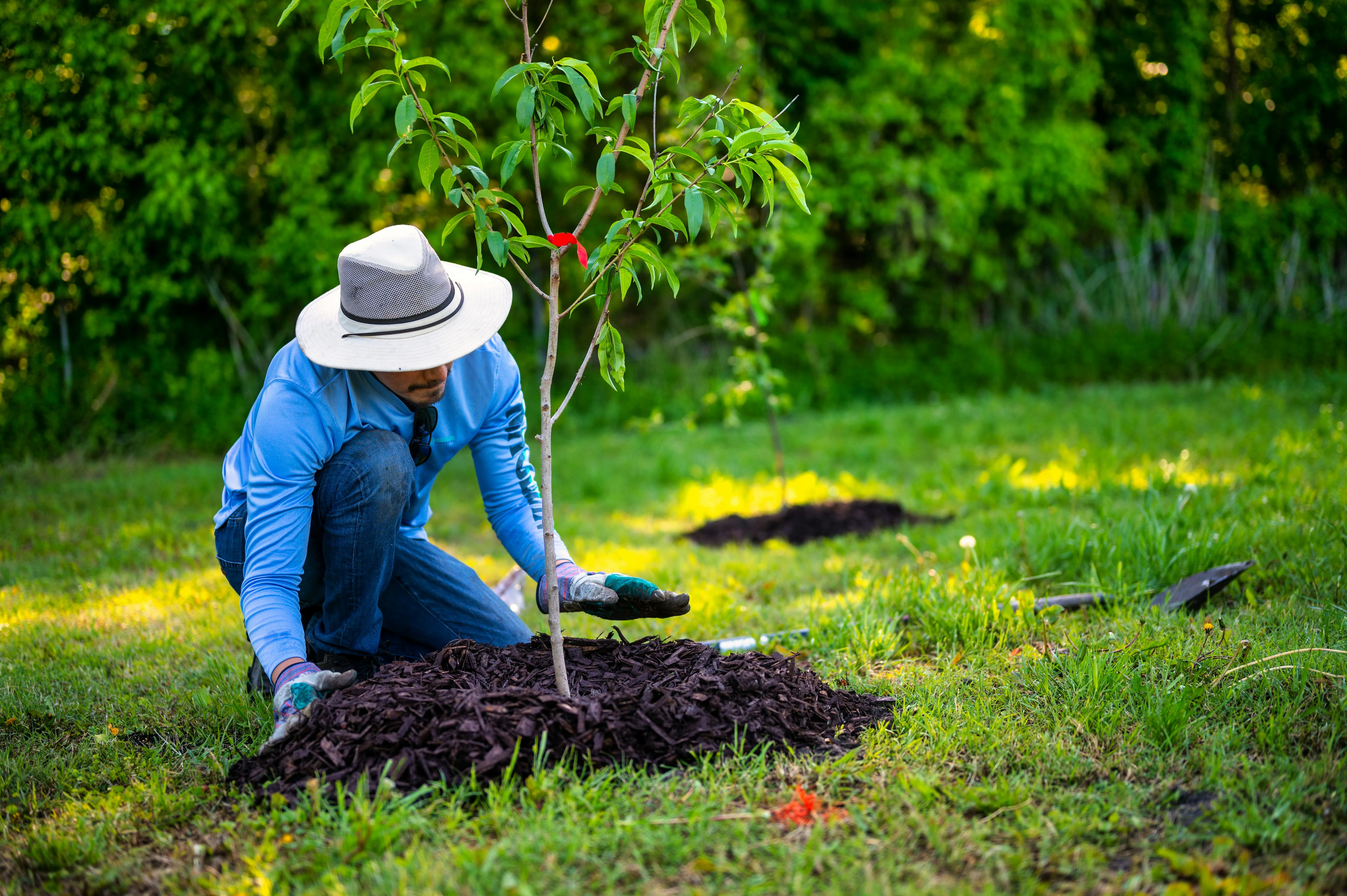
Extension guidance is specific here, and it is right for Charlotte ground. The hole is only as deep as the root ball and at least two to three times as wide. On very poorly drained spots, the root ball sits on a mound about 6 inches high in the middle of the hole. The backfill is not amended. Container plants get their circling roots teased out or cut, because roots that keep circling can girdle and eventually kill the plant. Every tree goes in with its root flare visible at the surface.
Mulch and cleanup
Mulch goes down 2 to 3 inches deep and is kept at least 6 inches back from trunks and crowns, which matches Extension guidance. That is not the deep mulch volcano you see around a lot of trees, which holds moisture against the bark. Pine straw, shredded hardwood and pine bark nuggets all work here.
Lawn edges and sod
Where beds change, the lawn changes too. Tall fescue is the usual lawn in shade and part shade around Charlotte, while bermuda and zoysia want full sun. Our Charlotte grass types guide covers which fits your yard. New bed lines also change the mowing pattern, which is why the plan should draw edges a mower can follow and why it is worth coordinating with your lawn mowing schedule.
How does Charlotte’s red clay change a landscape design?
It changes almost every decision. Piedmont red clay is acidic, often pH 5.0 to 6.0, and once construction compacts it, water soaks in slowly. So beds get prepared as whole areas, plants sit at or slightly above grade, wet spots get raised or drained, and lime and fertilizer follow a soil test instead of a guess.
Much of the upland soil across the Piedmont belongs to the Cecil series, which USDA describes as a very deep soil with a red clay subsoil, formed from weathered igneous and metamorphic rock. On paper it is classed as well drained. In a real Charlotte subdivision, though, the topsoil was often scraped off during grading and the clay underneath was driven over by trucks for months. What is left can shed rain like a tarp in some spots and hold it like a bowl in others. Our Charlotte soil guide goes deeper into the chemistry.
Test before you plant
The NC Department of Agriculture soil lab tests samples for free from April 1 through November 30, 2026, and charges $5 per sample starting December 1, 2026. A test tells you how much lime the bed actually needs, which keeps you from liming acid-loving plants like azaleas and blueberries into trouble.
Build up where you cannot drain down
If a bed sits low and stays wet, digging deeper just makes a bigger bathtub. The fix is raising the planting area with amended soil, shaping a berm, or giving the water somewhere to go. Plants that love wet feet, like river birch or inkberry holly, can also turn a soggy corner into a feature instead of a problem.
Rain comes in bursts
The National Weather Service puts Charlotte’s normal yearly rainfall at about 41.6 inches, with monthly normals between roughly 3 and 4.2 inches. Real years swing hard around that: 2016 came in at 33.55 inches and 2018 at 59.13. A landscape here has to handle both a dry September and a week of tropical rain, which is why every plan should show where water goes in a heavy storm.
Which plants work best in a Charlotte landscape?
Plants native to the Carolina Piedmont, plus well-proven adapted species, do best. Charlotte sits in USDA hardiness zone 8a on the 2023 map. Good picks include oakleaf hydrangea, serviceberry, eastern redbud, native viburnums, coneflowers, black-eyed Susan, little bluestem and muhly grass. They handle clay, humidity and heat with less water than many imports.
Flowering perennials
Purple coneflower, smooth coneflower, black-eyed Susan, butterfly weed and native asters carry color from late spring into fall. They want sun and a bed that drains, so they go on the high side of the grade, not in the low corner.
Shrubs for structure
Oakleaf hydrangea handles part shade under pines and hardwoods. Native viburnums and serviceberry give spring flowers and fall color. Hollies and a few boxwoods still have a place in formal foundation plantings, and inkberry is a native option for wetter ground.
Grasses
Little bluestem, switchgrass and muhly grass give movement and winter texture, and muhly’s pink fall plumes are one of the best shows in a sunny Charlotte bed. They also hold slopes well once they are rooted.
Trees
Flowering dogwood and eastern redbud anchor smaller yards and shaded spots. Tulip poplar is a big native shade tree for properties with room. A Japanese maple works in a protected spot with afternoon shade. Whatever the tree, the plan should show its mature spread so it is not jammed against the house or under a power line in ten years.
When is the best time to plant a new landscape in Charlotte?
Fall is the best window, from late September through November, while the soil is still warm and the air has cooled. Early spring, March and April, is the second choice. NC State Extension notes container plants do best, with the least watering, when planted in late fall or early spring. Midsummer planting works but needs constant water.
Freeze timing is worth knowing too. Over the last ten winters on National Weather Service records for Charlotte, the first fall freeze arrived anywhere from October 19 to November 29, and the last spring freeze came between March 7 and April 23. Each of those winters logged between 40 and 59 freezing days. So tender annuals wait until late April, while trees and shrubs can go in through most of the winter when the ground is not frozen or soaked. Our frost dates and growing season guide has the details.
Can I plant a new landscape during Charlotte’s Stage 2 water restrictions?
Yes. Charlotte Water has had mandatory Stage 2 restrictions in place since May 15, 2026, and its rules still allow hand watering and drip irrigation, including soaker hoses, for plants and gardens. Sprinklers are limited to assigned overnight windows. New beds on drip are fine. New sod watered by sprinklers is the hard part.
Charlotte Water says variances will not be approved for routine fall lawn work like aerating, overseeding or reseeding an existing lawn. It may still consider them case by case when watering is needed to establish vegetation required for erosion control, and it asks people to allow up to 7 calendar days for a reply. What that means for a design right now: beds get drip from day one, sod areas may get shrunk or pushed to a later phase, and plant choices lean further toward species that settle in with less water. Check our Charlotte watering restrictions page for the current stage before you plan a large lawn.
Do I need a permit for landscaping in Charlotte?
Usually not for planting your own yard. The city’s tree save and planting requirements exclude the homeowner of an existing single-family or duplex home. But you do need a city permit to plant, remove or cut trees and shrubs in the street right-of-way, or to dig within the drip line of a public tree.
Street trees and the right-of-way
Charlotte’s tree ordinance, City Code Chapter 21, says nobody may plant a tree or shrub on a public street right-of-way, or cut, prune or remove one there, without a written permit from the city. It also bars excavation or construction within the drip line of any tree whose trunk is on public property without a permit. That catches a lot of front-yard projects, because the strip between sidewalk and curb, and often a band behind the sidewalk, is public. The ordinance defines a tree’s root protection zone as generally 18 to 24 inches deep, out to half the tree’s height or its drip line, whichever is greater.
Walls, structures and HOAs
Planting does not need a building permit, but a retaining wall over a certain height, or anything with electrical or plumbing work, does. Our hardscape page covers those thresholds. If your neighbourhood has a homeowners association, its architectural review rules may require approval before front-yard changes, so send the plan to the HOA before the build date is set.
Before you sign any contract, our guide on how to choose a landscaper in Charlotte lists the questions worth asking about scope, timing and what the price includes.
Can I redesign an existing landscape instead of starting over?
Yes, and most Charlotte projects work that way. Assess what is there, keep the healthy, well-placed trees and shrubs, take out what is not working, and build the new beds and features around what stays. Keeping a mature dogwood or a good holly row saves money and years of waiting for fill.
Phasing works well with a redesign. A common pattern is the front yard in spring, the backyard in fall, then specialty beds or a patio the year after. Each phase is drawn on the same master plan, so the pieces match when they are done. It also lets you see the first phase settle in before committing to the next.
How do I take care of a new landscape after it is built?
Water is the whole first season. NC State Extension says 1 to 3 gallon trees and shrubs need 3 to 5 gallons of water twice a week during establishment when it does not rain. After that, keep mulch at 2 to 3 inches, pull weeds while they are small, and hold off on heavy pruning until plants have rooted in.
- First summer: check drip zones are running, and hand water anything that wilts by late afternoon. Under Stage 2, hand watering and drip are both allowed.
- First fall: top up mulch where it has thinned, and keep it pulled back from trunks.
- Year two: light shaping, fertilizer only if the soil test calls for it, and dividing perennials that have filled in.
- Every few years: a fresh soil test, since clay pH drifts back down after liming.
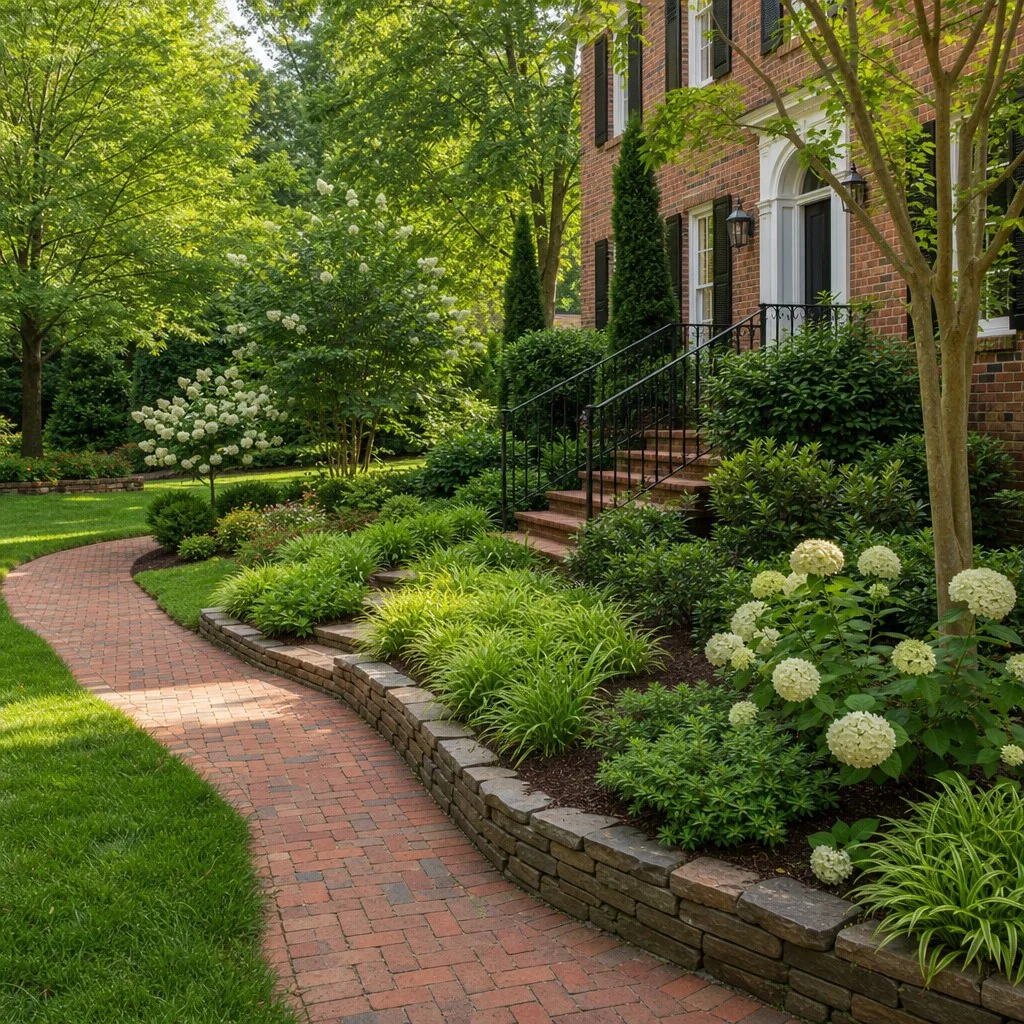
What does a typical Charlotte design scope look like?
Three scopes cover most lots: a front foundation bed refresh, a sloped backyard with a soggy low end, and a full-property plan with a patio. These are typical scopes, not quotes and not descriptions of a particular customer’s job, written to show what a plan should settle before anyone digs.
A typical front foundation bed refresh on compacted clay
A 1990s or 2000s house with overgrown foundation shrubs, about 400 square feet of beds along the front, and soil that stays wet near the downspouts. The plan removes old shrubs and roots, regrades and amends the bed, adds drip for the front beds and sets mulch at 3 inches. The local complication is that the clay under the old shrubs is usually dense and sour, so the bed is raised slightly to drain away from the slab and the downspouts are extended past it.
A typical sloped backyard with a soggy low end
A backyard that drops toward the rear fence, with a bare, muddy strip at the bottom after every storm and patchy fescue. The plan redirects flow with regrading, adds a French drain along the low edge, reseeds or resods, and builds new beds on drip. Under Stage 2, a large sod area watered by sprinklers is hard to establish, so the plan may hold the sod for a later phase, or shrink it and widen the beds on drip.
A typical full-property plan with a patio
A sunny lot where the owners want a usable backyard, new lawn and beds front and back, all on one plan. The patio is built first so equipment does not cross finished beds, irrigation goes in before sod, and sod waits for a season when it can actually be watered in. This is the scope where phasing earns its keep.
Where in the Charlotte area does this planning apply?
Across Charlotte and the surrounding towns, including Matthews, Mint Hill, Huntersville, Cornelius, Davidson, Mooresville, Concord, Harrisburg, Kannapolis, Indian Trail, Waxhaw, Belmont and Gastonia. Soil, slope and HOA rules vary a lot from one of these towns to the next, so every plan should start with a site walk.
Town pages: Matthews, Mint Hill, Huntersville, Cornelius, Davidson, Mooresville, Concord, Harrisburg, Kannapolis, Indian Trail, Waxhaw, Belmont and Gastonia. You can also see all the areas we serve.
Ready to plan your yard? Call (704) 318-2474 or request a free quote and we will talk through the plan before you collect bids.
How should the property details organize Landscape Design?
Charlotte design reviews Piedmont clay, fescue shade, stormwater paths, native Carolina plantings, and the irrigation zones that fit the lot.
Process Overview
- Site assessment and consultation
- Written estimate with line-item scope
- Scheduled work window confirmed
- Crew executes against the written estimate
- Completion walkthrough with the homeowner