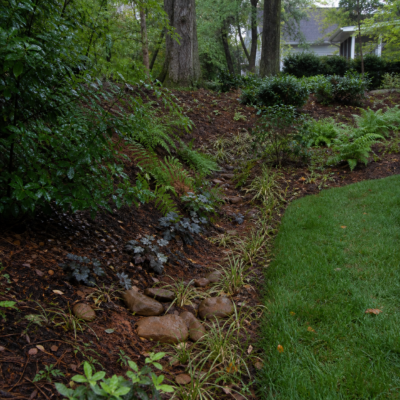
Charlotte Pro Landscape handles leaf removal across Charlotte, NC, from one-time fall cleanups to repeat visits through the season. We clear lawns, beds, and hard surfaces, then haul everything away. A typical fall cleanup runs $200 to $500 depending on lot size and tree cover. Call or request a free quote to book.
Call (704) 318-2474 or get a free quote.

How much does leaf removal cost in Charlotte, NC?
A fall leaf cleanup in Charlotte typically runs $200 to $500 per visit, the range published in our 2026 cost guide. Where your yard lands depends on lot size, how many mature hardwoods hang over it, whether beds and fence lines are included, and whether we haul the leaves away or bag them in paper for city pickup.
| Service or option | Typical range |
|---|---|
| Fall or spring cleanup, per visit | $200 to $500 |
| Fall aeration and overseeding for fescue, often paired with cleanup | $200 to $500 |
| Mulch and bed installation | $60 to $120 per cubic yard installed |
| County yard waste center, if you haul fewer than 5 bags (32 gallon) or 6 paper bags yourself | No charge |
| County yard waste center, larger loads piled no higher than 2 feet | $8.00 per unit |
| County yard waste center, weighed loads | $40.00 per ton, $16.00 minimum |
The first three rows are from our Charlotte landscaping cost guide. The county rows are from Mecklenburg County’s yard waste disposal page, and they’re here so you can price the do-it-yourself route honestly. Free drop-off sounds good until you count the trips.
What moves a leaf removal quote up or down
- Tree count and type. Ten or more mature hardwoods over a yard turns one visit into several.
- Lot size and layout. A flat, open quarter acre clears fast. A fenced backyard with one narrow gate doesn’t.
- Beds. Blowing out shrub lines and planting beds without stripping the mulch takes longer than open turf.
- Where the leaves go. Haul-away costs more than staging paper bags at the curb, because of loading time and disposal.
- How wet it is. Leaves that have sat on wet clay for weeks are heavier and slower to move.
- Extras. Gutter clearing and storm debris are quoted as separate line items, so you can see what each one costs.
Does the City of Charlotte pick up leaves?
Yes, but only if you package them. Solid Waste Services collects yard waste weekly on your regular day, and leaves have to be in paper bags or containers no larger than 32 gallons, each weighing no more than 75 pounds. Plastic bags aren’t accepted. For vacuum service on loose leaves, Mecklenburg County points residents to private companies.
These are the details that trip people up, all from the city’s collection guidelines:
- Set yard waste out by 6 a.m. on collection day, and no sooner than the day before. Setting out early can bring a citation of at least $150.
- Compostable plastic bags count as plastic. They aren’t accepted either.
- Limbs and brush can’t be longer than 5 feet or thicker than 4 inches. Piles can’t be more than 5 feet long and 3 feet high, with 2 feet between piles.
- The city asks residents not to blow yard waste into the street.
On a wooded lot, that’s a lot of paper bags. One mature oak can fill more of them than most people want to drag to the curb, and that’s where a crew with a truck earns its keep.
What are the leaf collection rules in the towns around Charlotte?
They’re different in every town. Cornelius runs a leaf vacuuming service for leaves at the curb from November 1 to January 15. Concord collects loose leaves from late October or early November to February. Davidson takes bagged yard waste, up to 20 bags a week. Unincorporated Mecklenburg County has no curbside collection at all.
- Cornelius: weekly yard trimmings on garbage day, plus the seasonal curbside vacuum. Limbs can’t be larger than 5 inches across or longer than 4 feet.
- Davidson: bags no larger than 40 gallons and no heavier than 50 pounds, limbs under 6 feet long and 4 inches across, and no more than 4 cubic yards in total.
- Concord: don’t mix limbs or rocks into a loose pile. After the season ends, leaves go in brown paper lawn bags. A late second-chance collection costs $75.
- Huntersville: yard waste is collected weekly, and large amounts are collected for a fee based on size.
- Matthews, Mint Hill, and Pineville: weekly yard waste through the town’s hauler, each with its own bag and limb limits.
- Unincorporated areas: residents contract with a private hauler.
The Mecklenburg towns are summarized on the county’s municipal curbside collection page, and Concord publishes its own loose leaf schedule. Rules change, so check your town before the first pile goes out. When we quote a property outside the city, we plan the cleanup around that town’s program. If a vacuum truck is coming, we can stage leaves at the curb. If it isn’t, we haul.
When should leaves be removed in Charlotte?
Plan on more than one pass. Mecklenburg County describes a six-week fall leaf season, and NC State’s tall fescue calendar still lists leaf removal as a December through February task. Oaks hold their leaves long after the maples are bare, so yards under mature canopy need repeat visits, not one big cleanup.
Why the season runs long here
There’s a lot of canopy to deal with. A University of Vermont study done with TreesCharlotte measured tree cover at 45 percent of the city in 2018. The willow oaks that line streets in Myers Park, Elizabeth, and Dilworth were planted when those neighborhoods were developed in the early 1900s, and they’re big trees now. Big oaks don’t drop on a schedule. They let go in waves, and the last wave can land well into winter.
How we time the visits
- First pass, once the early droppers are down. This visit matters most on lawns that were overseeded in September.
- Main pass, when the bulk is on the ground. This is the heavy one, and the one most people think of as the whole job.
- Final pass, after the oaks finish. It clears what’s left so the lawn isn’t sitting under a mat until spring.
NC State Extension puts Piedmont overseeding between September 1 and October 1, so early passes on a freshly seeded lawn are done gently, with blowers kept low and no hard raking that would pull seedlings.
Leaf season calendar for the Charlotte area
| Month | What’s happening |
|---|---|
| September | Piedmont fescue overseeding window, September 1 to October 1. Keep early leaves off new seed. |
| October | The earliest first freeze of the last ten seasons fell on October 19. Concord’s loose leaf collection starts in late October or early November. |
| November | Cornelius curbside vacuuming begins November 1. Plan the main cleanup. |
| December | Oaks are still dropping. NC State’s calendar says to mow fescue to 3 inches and remove leaves. |
| January | Cornelius vacuuming ends January 15. Final pass on oak-heavy lots. |
| February | Concord’s loose leaf season ends. Last winter cleanup before spring growth. |
Can I just mulch the leaves into the lawn?
Sometimes. NC State Extension’s rule of thumb is simple: if you only have a few leaves, run the mower over them and leave the pieces on the lawn. If you can’t see the grass through the leaves, they need to come up. Under mature oaks in Charlotte, most yards cross that line by mid-season.
We use the same test. A light layer on established turf gets mulch-mowed, which is faster and cheaper for you than hauling. A thick layer gets removed. New grass is the exception. A lawn seeded this fall shouldn’t carry a leaf layer at all, because seedlings need the light.
Chopped leaves also make decent bed mulch. If you’d like them kept on site, tell us at the walkthrough and we can spread them evenly in the beds you choose and skip the loading.
How do Charlotte’s clay soil and weather affect leaf cleanup?
Charlotte’s red clay drains slowly, so a wet layer of leaves stays wet and keeps the grass underneath dark and damp. That matters most on fescue that was just overseeded. Winters here are mild but real: National Weather Service records put Charlotte’s first freeze between October 19 and November 29 over the last ten seasons.
Soil
Piedmont red clay is acidic, often pH 5.0 to 6.0, and it compacts easily. Water doesn’t move down through it quickly, so anything that holds moisture at the surface, like a mat of oak leaves, holds it for a long time. It’s also why we keep heavy equipment off saturated lawns. Ruts in wet clay don’t bounce back. There’s more in our Charlotte soil guide.
Rain and cold
The National Weather Service’s normals for Charlotte show 3.14 inches of rain in November and 3.25 inches in December, so leaves on the ground here rarely stay dry for long. Wet leaves pack down, and packed leaves are what smother turf. NC State’s fescue calendar says to mow to 3 inches in winter and remove leaves and other debris. Its bermudagrass calendar gives the same winter instruction, so warm-season lawns in Ballantyne or Steele Creek don’t get a pass either.
This year’s drought
Fall 2026 has an extra wrinkle. Charlotte Water declared Stage 2 mandatory restrictions on May 15, and they were still in force when we checked on September 30. Fall aerating and overseeding aren’t eligible for a watering variance, so new seed only gets sprinkler water in the two assigned overnight windows each week. Seedlings already short on water can’t also sit under leaves. Our fall overseeding guide covers the timing, and the watering restrictions page has the current schedule.
Can I blow leaves into the street, push them into a storm drain, or burn them?
No to all three. The City of Charlotte asks residents not to blow yard waste into the street. Mecklenburg County warns that leaves pushed into storm drains clog a system with more than 100,000 drains. And the county Fire Marshal’s Office says burning yard waste in barrels, fire pits, or on the ground isn’t allowed.
The county’s own math makes the point. In its fall cleanup guidance, it figures that if just 1 percent of households pushed their leaves into the drain through the six weeks of fall, that would put 456,000 gallons of yard waste in the storm system. The burning rule is from a Fire Marshal’s Office release, and it applies even when no burn ban is in effect. Our crews keep leaves out of the gutter line, and the last thing we do on a visit is check that the curb and any yard drains are clear.
What our leaf cleanup covers
Lawn leaf removal
Front, back, and side yards cleared to the turf. Light cover is mulch-mowed and heavy cover is collected. This is the core of every visit, and it’s what the $200 to $500 range is built around.
Bed and shrub line cleanout
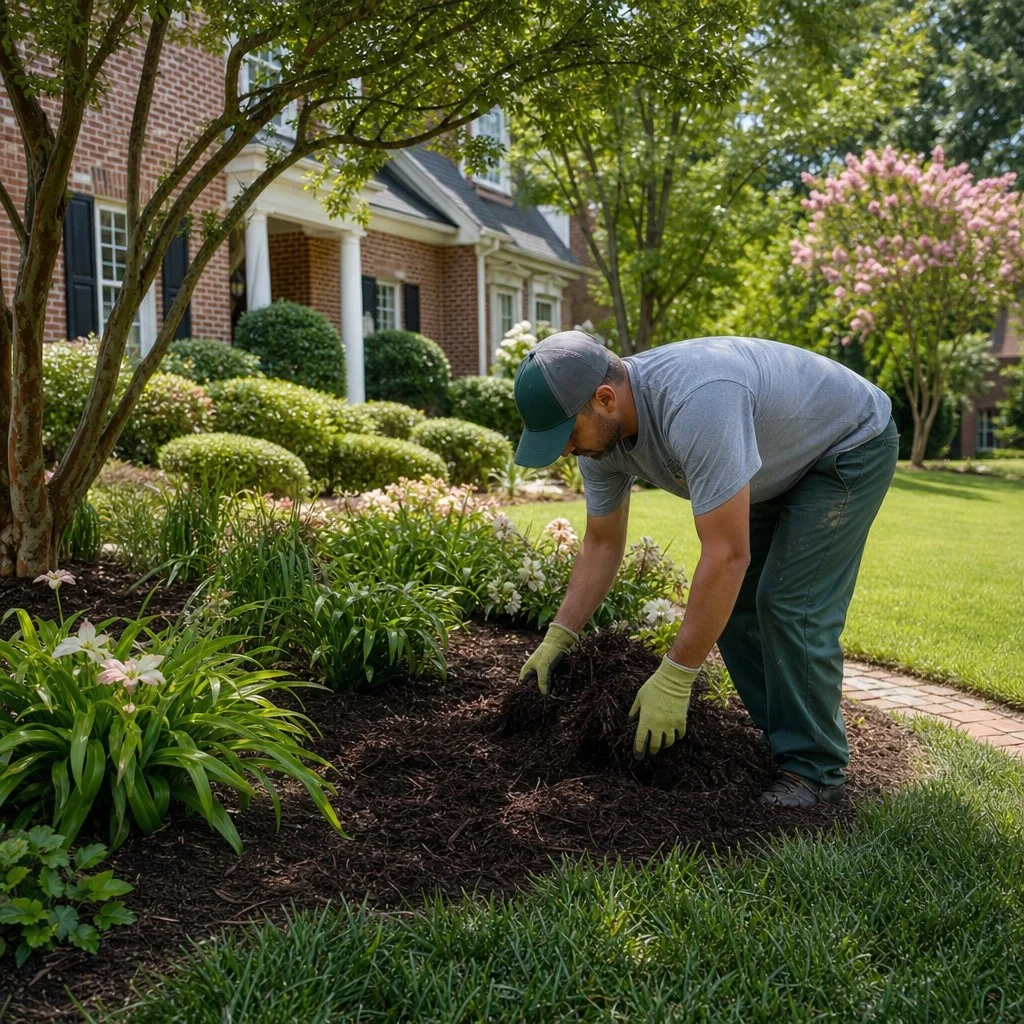
Leaves are blown out of planting beds, hedges, and foundation plantings at low throttle so the mulch stays put. If beds need a refresh afterward, installed mulch runs $60 to $120 per cubic yard. On clay, a mulch layer protects the soil surface through the winter rain.
Hard surfaces and the curb line
Walks, patios, driveways, steps, and the gutter line are cleared last, after everything has been moved off the turf. Wet leaves on pavers and concrete are slick, and they leave brown stains if they sit.
Haul-away or paper bagging
Most of the time, hauling is the simpler choice. If you’d rather use city collection, we bag in paper and stage it for your day, keeping each bag under the 75-pound limit and inside the set-out window.
Storm debris
Wind, ice, and summer thunderstorms drop limbs across Charlotte yards. We clear what can be cut and carried with a chainsaw. Anything that needs a bucket truck or climbing gets referred to an arborist. For city pickup, limbs are cut to 5 feet and stacked to the pile sizes the guidelines require.
Gutters
Gutter clearing isn’t folded into the leaf price. It’s listed as its own line on the quote when you ask for it, because roof height and access change the work.
Spring cleanup
Same $200 to $500 range, different work: leftover leaves out of beds, perennials and ornamental grasses cut back, bed edges redefined, and winter debris hauled. We also point out anything winter did to edging, irrigation heads, or drainage, and quote it separately.
How does a leaf removal visit work from first call to final pass?
It starts with a walkthrough and a written price, then one or more scheduled visits where we clear beds first, collect the leaves from the turf, remove them, and finish the hard surfaces. Most single visits on a typical residential lot take a crew a few hours. Heavily wooded lots take longer.
- Call or quote request. Tell us the address, roughly how many big trees you have, and whether you want haul-away or curb staging. That’s enough for us to plan a walkthrough. It takes a few minutes.
- Walkthrough and written quote. We look at canopy, turf, beds, hard surfaces, gates, and drains, and we ask where the leaves should go. You get a written price per visit and a suggested number of visits. Plan on 20 to 30 minutes on site.
- Edges and beds first. Beds, fence lines, and corners are blown out onto open turf. Doing this first means the lawn only gets cleared once. On most lots it’s the first half hour to an hour of the visit.
- Collection. Leaves are moved with blowers onto tarps or into rows, and light cover is mulch-mowed. This is the bulk of the time. What slows a crew down: wet leaves, hidden irrigation heads, and pet waste.
- Removal. Leaves are loaded and hauled, or bagged in paper and staged for your collection day. Bags stay under the city’s 75-pound limit and go out no sooner than the day before.
- Hard surfaces and drains. Walks, drives, patios, and the curb line get a final pass, and yard drains and downspout outlets are checked. This usually takes 15 to 30 minutes.
- Next visit. Before we leave, we look up. If there’s still a lot of leaf in the trees, the next visit is set by how fast it’s coming down, not by a fixed calendar.
Example scopes and what they’d cost
These are typical scopes priced with our published ranges. They aren’t quotes, and they aren’t descriptions of specific jobs.
Example scope: quarter-acre lot under street oaks, three visits
Site: a typical older-neighborhood lot with mature oaks at the street and a fescue lawn. Scope: three visits spaced through the season, each covering lawn, beds, hard surfaces, and haul-away. Local complication: the oaks keep dropping after the other trees finish, so a single visit would leave the lawn covered for weeks. Price math: three visits at $200 to $500 each comes to $600 to $1,500 for the season.
Example scope: small lot, one late cleanup, city pickup
Site: a small lot with two or three trees, where the leaves were left until everything was down. Scope: one visit, lawn and beds cleared, leaves bagged in paper and staged at the curb for the city. Local complication: the leaves have been rained on, so bags reach the 75-pound limit quickly and it takes more of them. Price math: one visit inside the $200 to $500 range, with no haul-away charge.
Example scope: early leaf pass with fescue overseeding and a mulch refresh
Site: a thin fescue lawn on red clay with foundation beds. Scope: an early leaf pass, core aeration and overseeding, and 4 cubic yards of mulch once the beds are clean. Local complication: under Stage 2 the new seed is only watered twice a week, so leaves can’t be allowed to cover it. Price math: cleanup at $200 to $500, aeration and overseeding at $200 to $500, and mulch at $60 to $120 per cubic yard ($240 to $480) adds up to $640 to $1,480.
Do you offer one-time leaf cleanup or a seasonal program?
Both. A one-time cleanup suits a small lot or a late-season catch-up. For properties with ten or more mature hardwoods, one pass isn’t enough, so we schedule repeat visits tied to leaf drop and price each visit up front. Spring cleanups and storm debris call-outs are booked the same way.
Is it cheaper to handle leaf removal myself?
It can be, if you have the time and a small lot. City pickup comes with your regular service but requires paper bags under 75 pounds, set out no sooner than the day before collection. County drop-off is free for fewer than 6 paper bags and $8.00 per unit for bigger loads. Wooded lots are where hiring out pays.
The honest comparison is hours, not dollars. Bagging a heavy oak drop in paper takes most of a weekend, and it has to be repeated each time the trees let go. If your lot has two trees and a short driveway, do it yourself and keep the money. If you’re looking at a dozen hardwoods and a fenced backyard, a per-visit price is usually less than the value of the weekends.
Where do the leaves go after you haul them?
Yard waste in Mecklenburg County is composted. The county runs four drop-off centers that take leaves, brush, and grass clippings: Compost Central, Foxhole, Hickory Grove, and North Mecklenburg. The material becomes compost and brush mulch. That’s why plastic bags are kept out, since plastic doesn’t break down and contaminates the finished product.
What should I do before the crew arrives?
Not much. Unlock the gates, move cars off the driveway if you want it cleared, pick up pet waste and toys, and flag anything fragile hiding under the leaves, like irrigation heads, low lights, or new plantings. If you’re using city pickup, tell us your collection day so the bags go out on time.

Leaf removal service area
We remove leaves throughout Charlotte, including Myers Park, Dilworth, Elizabeth, Eastover, SouthPark, Ballantyne, and Steele Creek. Nearby towns we cover include Mooresville, Matthews, Cornelius, Davidson, Huntersville, Concord, and Mint Hill, plus Monroe, Pineville, Indian Trail, Gastonia, and Waxhaw. See all the areas we serve.
Ready to get the leaves off the lawn before they mat down? Call (704) 318-2474 or ask for a free quote. Tell us roughly how many big trees you have and we’ll take it from there.