
Last updated: September 30, 2026
Short answer: In Charlotte, pick pine straw for sloped or root-filled beds, where its interlocking needles hold and let air and water through, and shredded hardwood for flatter ornamental beds that want a crisp edge and slower replacement. NC State gives a 2- to 3-inch layer for pine needles and about 1 to 2 inches for shredded hardwood.
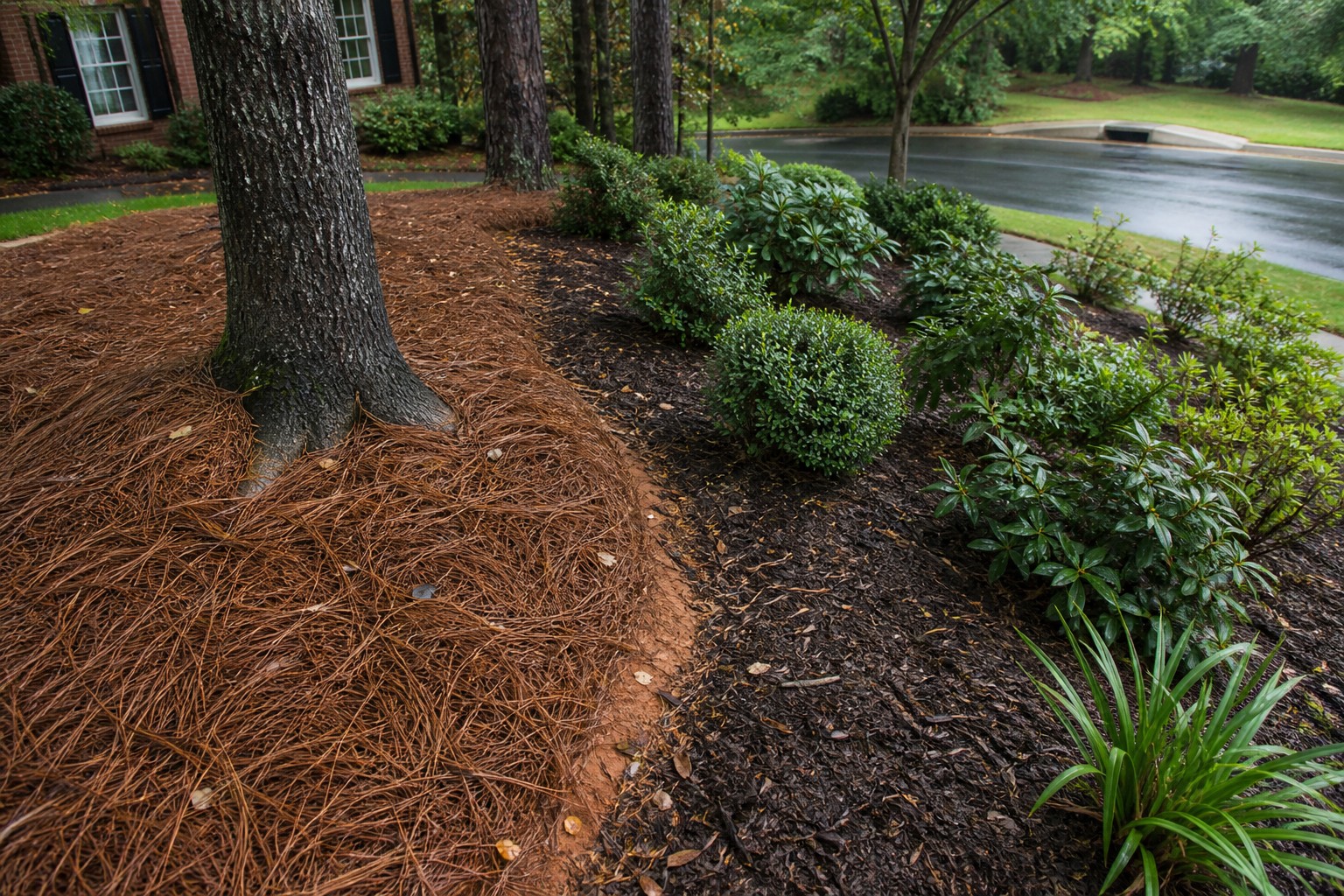
Pine straw and shredded hardwood can both protect a Charlotte planting bed, but they do not behave the same way. Pine needles interlock, admit air and water, and settle naturally around irregular ground. Shredded hardwood makes a defined, darker surface and decomposes more slowly, yet a layer that is too thick or fine can seal at the top. The useful choice is not which product wins everywhere. It is which material fits each bed zone and can be maintained at a measured depth.
Start with a bed map, not a material sample
Walk the property after rain and divide the beds by behavior. Mark the steep runs, flat shrub masses, tree root zones, seasonal flower pockets, curb edges, downspout outlets, and any route that carries leaves toward a street inlet. This creates a practical material map. A single front bed may reasonably use pine straw beneath mature trees and hardwood around a flat foundation planting.
| Charlotte bed condition | Better starting material | Reason to choose it | Condition to correct first |
|---|---|---|---|
| Moderate planted slope without concentrated roof discharge | Pine straw | Long needles knit together and resist ordinary surface movement better than loose, chunky material | Any bare channel showing that runoff is cutting through the bed |
| Flat foundation bed with established shrubs | Shredded hardwood | A thin, even layer provides a defined surface and normally needs less frequent full replacement | Material already piled against siding, stems, or vents |
| Mature tree with surface roots | Either, applied correctly | Both can cover exposed soil without cultivating through roots | Mulch or straw touching the trunk or hiding the root flare |
| Seasonal pansy or viola pocket | Fine organic mulch rather than pine straw | NC State reports reduced pansy performance with pine straw | Old matted material and buried plant crowns |
| Bed beside a curb inlet or drainage swale | Whichever stays contained after the water path is fixed | The drain boundary matters more than appearance | Flow that carries soil, mulch, needles, or leaves into the street |
This is a starting decision, not permission to cover a drainage defect. If runoff leaves a bare groove, deposits mulch at the curb, or exposes roots, first trace the source. A downspout extension, grading correction, planted flow path, or other site-specific drainage measure may be needed. The site’s Charlotte patio and runoff diagnostic shows how to record the water path before defining a separate repair scope.
When is pine straw the better mulch for a Charlotte bed?
On slopes and around established roots. NC State Extension describes pine needles as an organic mulch that lets air and water through and, thanks to its interlocking habit, works on slopes. Its Extension Gardener Handbook gives a 2- to 3-inch layer. One exception: NC State advises against pine straw around pansies, because it can reduce spring flowering.
NC State Extension describes pine needles as an organic mulch that allows air and water to move through and, because of its interlocking habit, works effectively on slopes. That physical behavior is the strongest reason to select it. Needles can wrap around established plants and surface roots without the visual weight of a deep wood layer.
Use pine straw only after removing debris that would make the finished depth impossible to judge. Fluffing a bale creates volume, but appearance is not a measurement. Probe several points with a ruler after settling. NC State’s Extension Gardener Handbook gives a 2- to 3-inch layer for pine needles. More is not automatically better, especially beside low crowns or against woody stems.
Pine straw also has a specific exception that matters in Charlotte’s common cool-season color beds: NC State advises against it around pansies because it can reduce spring flowering. A material that suits a slope beneath shrubs does not therefore belong inside every annual pocket.
Where does shredded hardwood mulch work best in a Charlotte yard?
On flat ornamental beds where a stable, dark surface defines the planting. It breaks down more slowly than lighter organic covers, so a refresh can mean restoring depth, not replacing everything. NC State recommends spreading it thinly, about 1 to 2 inches, to avoid an impermeable layer. Measure what’s there first, and reject sour-smelling mulch.
Shredded hardwood is useful where a stable-looking, dark surface defines a flat ornamental bed. It breaks down more slowly than several lighter organic covers, so a refresh may involve restoring depth rather than stripping and replacing everything. That makes the pre-work measurement important: adding the same nominal amount every season can quietly build an excessive layer.
NC State recommends spreading shredded hardwood thinly—about 1 to 2 inches—to avoid an impermeable layer. If the surface has become crusted, do not hide it under fresh material. Break a small test area by hand. Check whether water enters, whether fibrous roots are growing into the old mulch, and whether the layer can be separated from the soil beneath. The answer determines whether the bed needs a light top-up, loosening, partial removal, or a reset.
Colored products and species claims are secondary to delivered condition. Reject sour-smelling or anaerobic mulch. Record the product name and source on a material proposal, but judge the installed bed by texture, depth, containment, and clearance around plants.
Do not turn Charlotte clay into part of the mulch layer
The red or brown subsoil visible in many Piedmont cuts is not a reason to till wood mulch into the bed. Mulch is surface protection; soil amendment is a separate decision based on the planting objective and actual soil. Mixing partially decomposed wood into a root zone changes the material relationship and makes future depth harder to control.
Before a new planting, inspect drainage, compaction, and the actual profile rather than assuming every red soil behaves identically. The Charlotte soil guide explains why color alone cannot diagnose infiltration. For an established bed, avoid cultivation that damages tree and shrub roots. Remove only what is necessary, preserve the soil surface, and restore cover without burying crowns.
A visible root flare is a quality-control point
Mulch volcanoes are not extra tree care. They conceal the point where trunk tissue transitions to roots, hold moisture against bark, and make inspection difficult. Pull pine straw or hardwood away until the root flare can be seen. Keep plant crowns and woody stems clear as well.
Put that requirement in the installation What’s included: material should taper away from trunks, not form a wall around them. Photograph representative trees after cleanup and again after placement. A final depth number without a trunk-clearance check is incomplete.
How much area does a cubic yard of mulch cover?
One cubic yard holds 27 cubic feet. That covers about 162 square feet at 2 inches deep or 108 square feet at 3 inches, and spread over a flat 100-square-foot bed it makes a layer about 3.24 inches deep before settling. Pine-straw bales aren’t uniform, so ask for the bale type and count instead.
Hardwood quantities can be checked with simple geometry. One cubic yard contains 27 cubic feet. Spread across a flat 100-square-foot bed, that volume would make a layer about 3.24 inches deep before settling. The same yard covers about 162 square feet at 2 inches or 108 square feet at 3 inches. These are arithmetic conversions, not promises about compaction, waste, or an irregular bed.
Measure bed length and average width, subtract large hardscape or groundcover areas, then specify the intended finished depth. For curved beds, divide the shape into smaller rectangles and triangles rather than guessing from frontage. A contractor’s proposal should state whether quoted yards are delivered volume or final compacted depth.
Pine-straw bales are less uniform. Needle length, compression, bale dimensions, spreading style, and the existing layer all affect coverage. A universal bales-per-square-foot claim is therefore weak. Ask for the bale type and count, identify the mapped zones, and verify finished depth in the field.
How do you keep mulch out of Charlotte storm drains?
Charlotte Storm Water Services says yard waste in streets or on stream banks can wash into and clog storm drains and streams, and its guidance tells residents not to blow or rake leaves and clippings into drains. Treat mulch the same way: stage it away from the gutter, sweep paved surfaces, and recover displaced material after rain.
Charlotte Storm Water Services says yard waste in streets or on stream banks can wash into and clog storm drains and streams. Its public guidance directs residents not to blow or rake leaves and grass clippings into drains. The same operating rule should govern a mulch installation: stage material away from the gutter, sweep paved surfaces, and recover displaced straw or wood after rain.
Where a bed ends beside a sidewalk or curb, specify a containment detail and finished grade. A decorative edge that sits above the soil but below the mulch may still let material wash across pavement. Observe the edge during the first meaningful storm, not only on installation day.
Use a two-date acceptance check
Fresh material can disguise uneven depth and runoff for a few dry days. Check the work once at installation and again after settling or rain. The first visit confirms coverage, plant clearance, clean pavement, documented quantities, and a continuous edge. The second confirms that water enters the bed, no channel has opened, and material remains out of drains.
- At installation: record material, delivered quantity, mapped areas, finished depth, and excluded zones.
- At every tree: expose the flare and leave bark clear.
- At every plant: uncover the crown and low stems.
- At hard edges: sweep walks, drives, and gutters completely.
- After rain: photograph channels, migration, ponding, and drain approaches.
- Before the next refresh: measure the remaining layer rather than repeating last year’s order.
For a broader planting reset, connect the material plan to the site’s Charlotte landscape-design process. If price is the concern, compare proposals by measured area, finished depth, removal, edging, delivery access, and cleanup—not by an unqualified lump sum. The existing Charlotte cost guide is planning context, while this page defines the quantities that make mulch bids comparable.
Frequently asked Charlotte mulch questions
Is pine straw always better on a slope?
No. Its interlocking needles are useful on ordinary planted contours, but no loose surface cover should be asked to absorb concentrated downspout flow or repair an eroding channel. Correct the water path first.
How deep should shredded hardwood mulch be?
NC State’s material-specific guidance calls for a thin 1- to 2-inch layer of shredded hardwood. Measure the existing layer before adding more, and investigate a crusted surface rather than covering it.
Will pine straw make Charlotte soil acidic?
Not in the quick, dramatic way the common claim suggests. NC State notes that fresh needles are acidic but become neutral or slightly alkaline as they decompose, and surface mulches have little effect on soil pH below about 2 inches.
Should old mulch be removed every year?
Not automatically. Measure depth, test whether water penetrates, inspect for matting or sour material, and remove only what prevents the new finished condition. Routine full removal can waste material and disturb roots.
Sources and calculation notes
- NC State Extension Gardener Handbook: Herbaceous Ornamentals — material behavior, material-specific depths, slope use, pH context, and the pansy caution.
- NC State Extension: Plan Before You Plant — weed suppression, maximum organic-mulch depth, and slope stability principles.
- City of Charlotte: Create a Stormwater-Friendly Yard — runoff and yard-waste handling.
- City of Charlotte: Prevent Water Pollution — keeping leaves and clippings out of storm drains.
- Coverage figures are direct volume conversions: 1 cubic yard = 27 cubic feet; depth in feet multiplied by area equals volume. They exclude settling, waste, and bed irregularity.